What is in Mr. Potato?
 Feb 16, 2016 • 4:11 PM UTC
 Unknown Location
 140x Magnification
 Microorganisms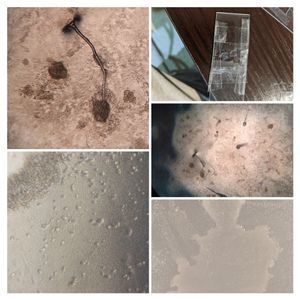
Laks Iyer
Human observer of life. https://sukshmadarshin.wordpress.com
97posts
1255comments
5locations

View in Media Gallery
The Potato that we eat today originated in the Andes of South America. We consume a storage organ of the plant called the tuber, which is a modified underground stem. All modern potatoes came from a single potato somewhere in modern Peru. I find this quite amazing. Up until about the late 1500s, the Potato wasn’t even part of the old world diet, but today it is the fourth most consumed food crop. The infamous Irish Potato famine resulted in a million deaths and a mass migration,causing the population of Ireland to fall by about 25%! It has indeed changed the world, as much as Chinggiz Khan, the famed or dreaded Mongol. I had more humble aspirations for the Potato. I wanted to study the tuber under the microscope with one of the DC micronauts; Aditi. The videos contain conversations, which I left behind as a record, so apologies in advance for inaccuracies in conversation. We sliced the potato with a hand microtome and made many thin slices. Here’s what we did with each slice.
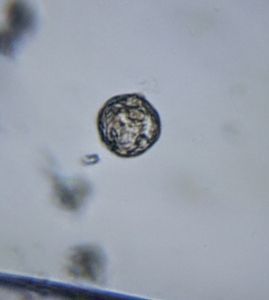
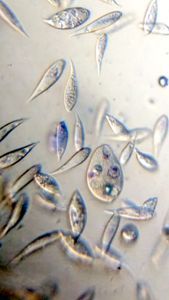
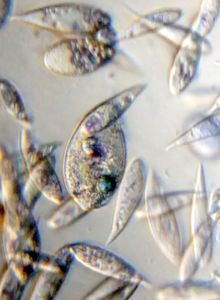
Viewing the unstained potato. Fascinating view of the modified chloroplast called the amyloplast, which makes starch and is rapidly converted to simpler sugar (energy) when the potato tuber sprouts new roots and shoots.
Viewing the unstained potato. Fascinating view of the modified chloroplast called the amyloplast, which makes starch and is rapidly converted to simpler sugar (energy) when the potato tuber sprouts new roots and shoots.
2. Potato tuber slice stained with iodine for about 30s and then washed with water. Starch reacts with iodine to give a nice dark purple color. It is amazing how the cell is filled with amyloplasts.
3, Potato tuber slice stained with methylene blue. Here the cell wall is well stained. It is interesting how you can barely see the nucleus and other organelles, while the amyloplast (which is a modified chloroplast) just inundates everything.
5. How does a cooked potato tuber look?
6. And what if we stain the cooked potato tuber with iodine?
The Potato cells are gigantic like the onion epidermis and make for some wonderful viewing. If you haven’t done it before, you should give it a try.
-Aditi and Laks
-Aditi and Laks
Sign in to commentNobody has commented yet... Share your thoughts with the author and start the discussion!
 0 Applause
 0 Comments
_300x300.jpeg)