MtA_BIOL2201_2026 The First Plants on Land!
 Apr 03, 2026 • 5:55 PM UTC
 Canada
 140x Magnification
 Plants
Sam Allanach
Learn about the author...
1posts
1comments
0locations
View in Media Gallery
As soon as I received my Foldscope, I knew that I wanted to observe some of my plants at home. I'm glad I did, because a lot of detail can be seen with the Foldscope than with the naked eye!

View in Media Gallery
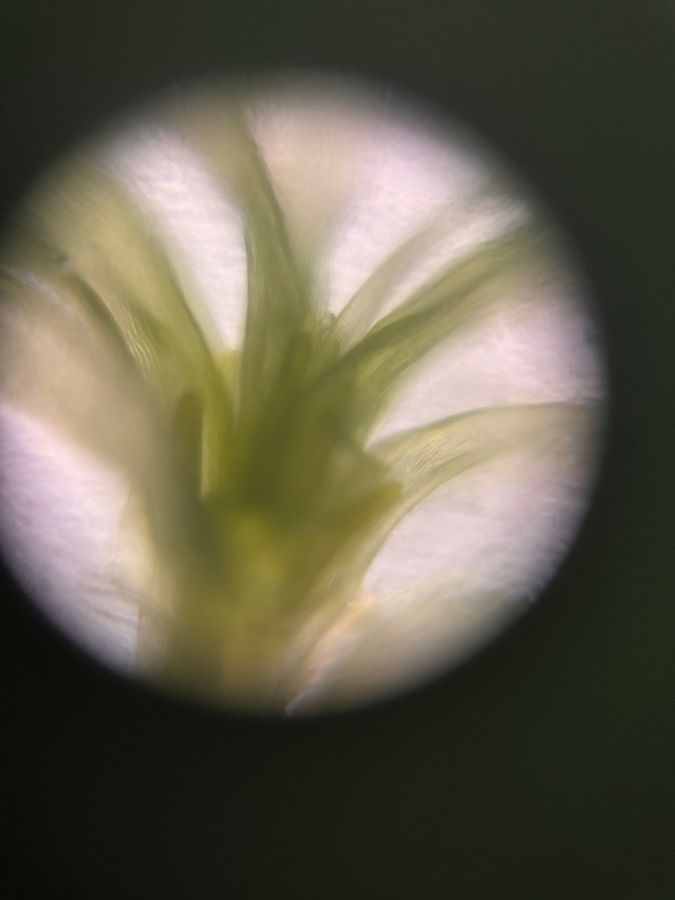
I decided to observe this moss surrounding one of my plants!
Mosses were the first plants to move from water to land. Like all modern land plants, they exhibit a complex life cycle that alternates between "gametophyte" (where they have one copy of each gene) and "sporophyte" (where they have two copies of each gene).
Mosses were the first plants to move from water to land. Like all modern land plants, they exhibit a complex life cycle that alternates between "gametophyte" (where they have one copy of each gene) and "sporophyte" (where they have two copies of each gene).

View in Media Gallery
This is a gametophyte of a “true moss” (Phylum Bryophyta) specimen that I found growing in my carnivorous plant greenhouse. Mosses enjoy similar a wet environment to most carnivorous plants. No veins can be seen in the thalli (leaves) since mosses evolved before vascular tissues. Without the structure of vascular tissue, mosses are limited to only a few centimetres in height. The long, unspecialized parenchyma cells can be seen as lines along the surface of the thallus. It is difficult to tell whether this gametophyte is sperm or egg producing, since both are near identical in morphology. Once fertilized, the gametophyte will produce a sporophyte...

View in Media Gallery
This is a sporophyte capsule from the same type of moss. It has already burst open to release more spores (similar function to seeds in more modern plants)! These spores will become the next gametophyte generation.
Sign in to commentNobody has commented yet... Share your thoughts with the author and start the discussion!
More Posts from Sam Allanach
No more posts from this author.