Pressure inside a tiny bubble
 Jan 25, 2015 • 11:17 AM UTC
 Unknown Location
 140x Magnification
 Non-Living
Manu Prakash
I am a faculty at Stanford and run the Prakash Lab at Department of Bioengineering at Stanford University. Foldscope community is at the heart of our Frugal Science movement - and I can not tell you how proud I am of this community and grassroots movement. Find our work here: http://prakashlab.stanford.edu
267posts
1198comments
42locations
View in Media Gallery
Bubbles are beautiful. Big or small; they hold such mysteries. You find them everywhere, and conceptually they show up at many many length scales. From the very big to the very small.
So here is a puzzle; what’s the pressure inside a tiny bubble. If you are trapped inside a tiny bubble; how much pressure (positive of negative) would you feel inside?
The answer to this mystery lies in just looking at the bubble. If you can find out how large the bubble is (radius of the sphere and what the surface tension is – you can calculate the pressure).
It turns out, pressure inside a bubble embedded in another fluid (such as water) is inversely propulsion to the radius of the bubble. So the smaller the bubble, the higher the pressure inside the same. If you compute numbers for water, a 3 micron bubble in diameter holds an additional pressure of roughly around 1 atm. That is roughly the same amount of additional pressure you would experience if you were at a depth of ~10m under water. Now if the bubble is only 0.3 micron in diameter, that pressure is 10 atm. That’s a lot of pressure packed inside a tiny little bubble. So whenever you see a bubble in your microscope, think about all this pressure packed inside.
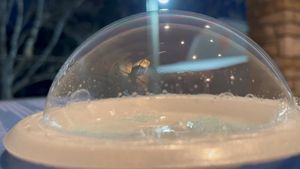
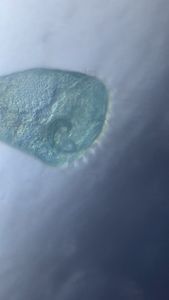
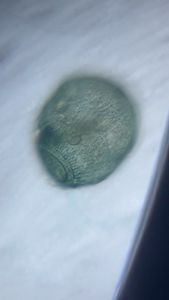
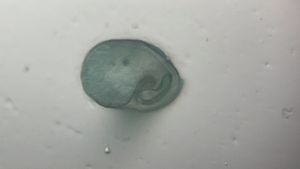
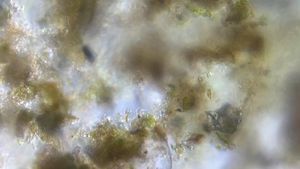
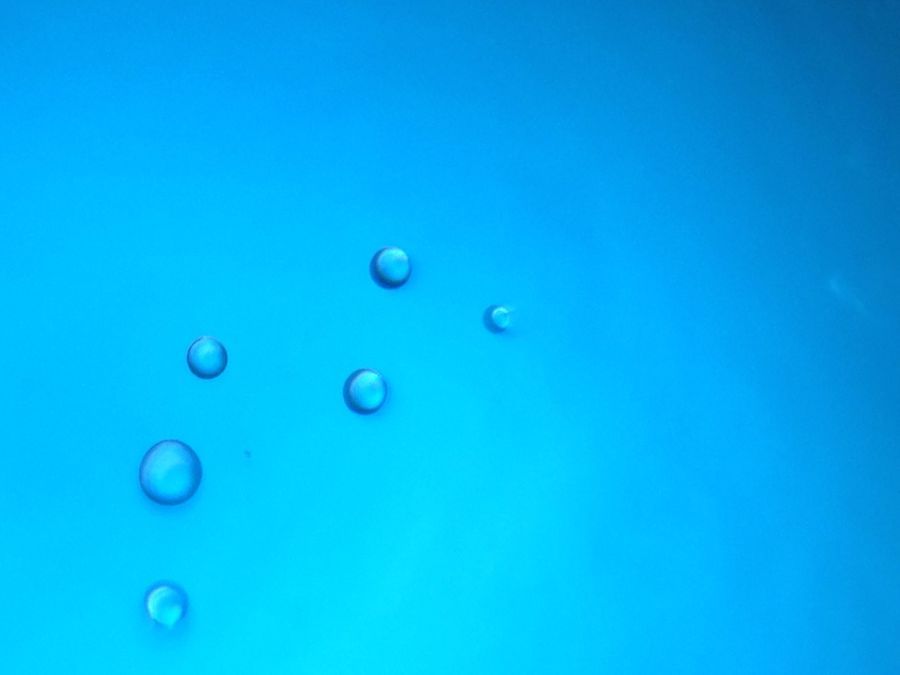
Here are a few bubbles I found in the water sample (some of them are around ~10 microns). They are perfectly spherical (why).
So here is a puzzle; what’s the pressure inside a tiny bubble. If you are trapped inside a tiny bubble; how much pressure (positive of negative) would you feel inside?
The answer to this mystery lies in just looking at the bubble. If you can find out how large the bubble is (radius of the sphere and what the surface tension is – you can calculate the pressure).
It turns out, pressure inside a bubble embedded in another fluid (such as water) is inversely propulsion to the radius of the bubble. So the smaller the bubble, the higher the pressure inside the same. If you compute numbers for water, a 3 micron bubble in diameter holds an additional pressure of roughly around 1 atm. That is roughly the same amount of additional pressure you would experience if you were at a depth of ~10m under water. Now if the bubble is only 0.3 micron in diameter, that pressure is 10 atm. That’s a lot of pressure packed inside a tiny little bubble. So whenever you see a bubble in your microscope, think about all this pressure packed inside.
Here are a few bubbles I found in the water sample (some of them are around ~10 microns). They are perfectly spherical (why).

View in Media Gallery
Can you find some more bubbles.
Sign in to commentNobody has commented yet... Share your thoughts with the author and start the discussion!

 0 Applause
 0 Comments