How does an N95 mask protect against pathogens?
 Mar 19, 2020 • 6:28 PM UTC
 Unknown Location
 140x Magnification
 Unknown
Adam Larson
Learn about the author...
7posts
5comments
1locations

View in Media Gallery
What is in an N95 mask, and how does it protect our healthcare workers against microscopic pathogens? To find out I deconstructed a broken N95 mask.

View in Media Gallery
The mask is composed of 4 layers, the bottom being the layer most exposed to external environments. They are bonded together on the exterior. Inner layers are often treated with metal ions which interact with viral particles to trap them inside. These masks are rated to trap most particles (95%) that are larger than 300µm. This is why they are most needed by healthcare workers in pathogen filled environments.

View in Media Gallery
The outer layer has fairly thick fibers of polypropylene and perforations.

View in Media Gallery
Inside the mask, beyond the outer layer, is a stiff layer of large polyester fibers.
View in Media Gallery
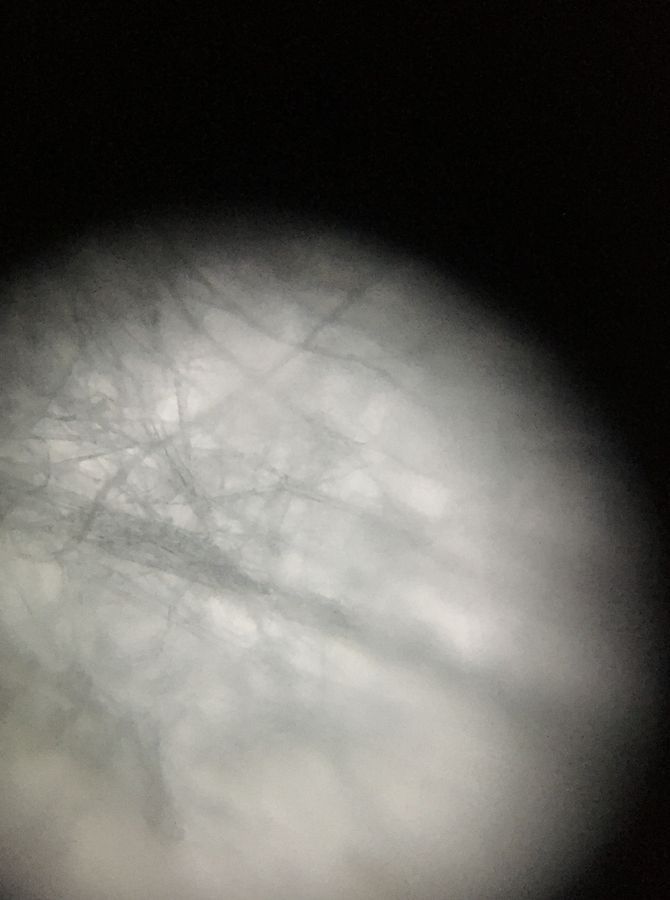
Behind this stiff layer of large filaments is a very dense pillowy network of melt blown polypropylene. This would be the main protection against submicron sized particles.

View in Media Gallery
The final layer next to the users mouth is mesh of different sized fibers, ranging from thick down to very fine.
Sign in to commentNobody has commented yet... Share your thoughts with the author and start the discussion!

 0 Applause
 0 Comments