Porpita porpita or Blue Button: A fascinating organism/s
 May 01, 2025 • 10:45 AM UTC
 India
India 140x Magnification
 Microorganisms
Dr Rafikh Shaikh
I'm a science educator interested in everything science.
115posts
92comments
20locations
View in Media Gallery
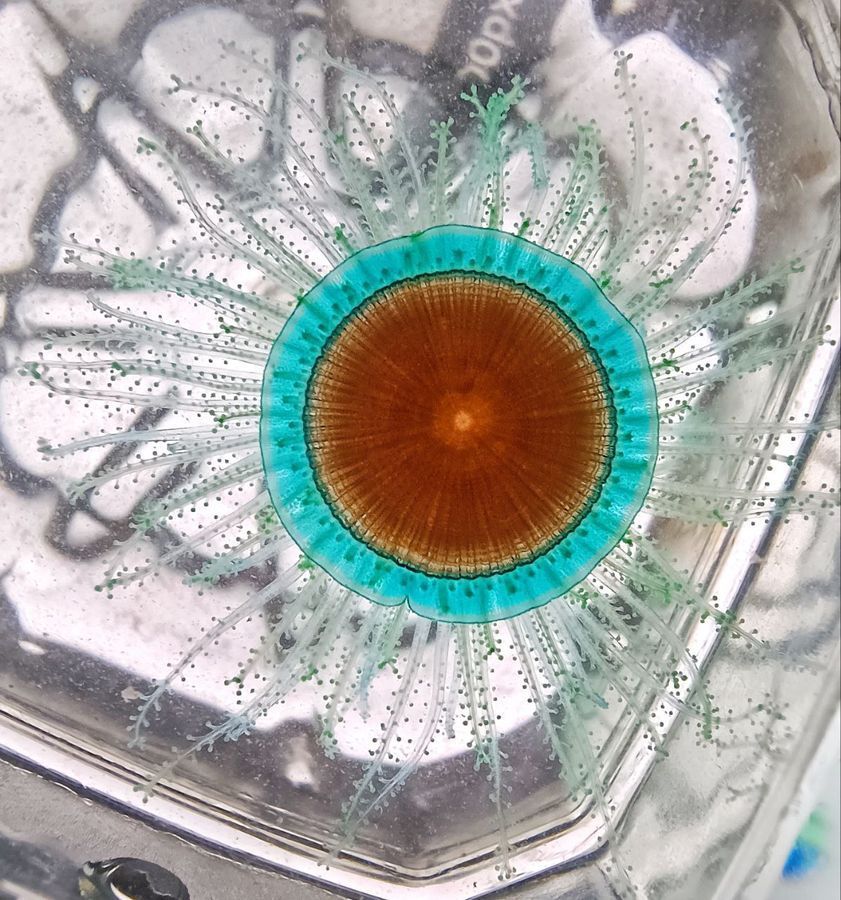
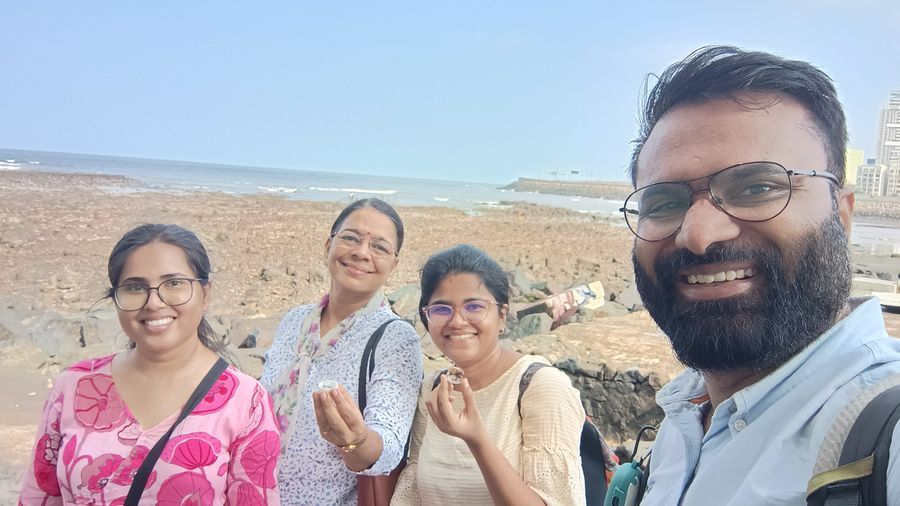
Over the past few days, my Instagram feed had been flooded with posts about Porpita porpita, also known as the Blue Button, being spotted along the Mumbai coastline. Curious and excited, I decided to check for myself. Along with fellow Foldscopers—Sonali, Rupali, and Anupama—I planned an early morning visit to the Haji Ali seashore on 28th April 2025.
View in Media Gallery
We reached the shore at around 7:20 am, full of hope but unsure of what to look for. None of us had seen P. porpita in real life before, and spotting them turned out to be harder than expected. We spent nearly an hour scanning the rocky coastline, eyes squinting at the waves, but found nothing. The coastline is full of surprises, but that morning it tested our patience.
Luckily, Rupali—our ever-curious and social teammate—started chatting with a group of photographers who seemed to be searching for something too. They were also looking for Porpita porpita to photograph. They told Rupali they had seen a few earlier that morning, and generously shared a tip: look for tiny blue circles about 1–2 cm in diameter, gently bobbing on the water’s surface. They suggested staying in one place and observing carefully.
Luckily, Rupali—our ever-curious and social teammate—started chatting with a group of photographers who seemed to be searching for something too. They were also looking for Porpita porpita to photograph. They told Rupali they had seen a few earlier that morning, and generously shared a tip: look for tiny blue circles about 1–2 cm in diameter, gently bobbing on the water’s surface. They suggested staying in one place and observing carefully.

View in Media Gallery
And that’s all it took. Within five minutes, Rupali, Sonali, and Anu spotted one. They called me over in excitement. And once we had a mental image of what to look for—it was like unlocking a secret. Suddenly, we could see them everywhere—delicately floating, drifting with the rhythm of the waves. In a patch of about 20 by 20 feet, we counted around 20 Blue Buttons.
What’s fascinating is that Porpita porpita is not a single organism, but a colony of specialized organisms (called zooids) working together, much like the more famous Portuguese Man o’ War. This colony mimics the behavior of a jellyfish. It has a central disc, often brownish, with radiating tentacle-like structures that help in both locomotion and catching prey like tiny crustaceans.
Given their delicate nature, we collected a few samples carefully—without touching them directly. They are fragile and easily damaged, so we scooped them into bottles along with seawater, ensuring minimal disturbance. We ended up with three bottles—one with me, one with Sonali and Rupali, and one with Anupama.
Back home, we began our observations. We clicked close-up photographs, watched them move, and planned to track what happens to them over time. I’ll be sharing my set of observations here, and hope to add notes from the others as well.
My Observations: The Gentle Decline of a Porpita Colony:
I collected my sample at around 8:30 am, with one colony floating in 15–20 ml of seawater inside a small plastic bottle. Once home, I cut off the top half of the bottle to make observations easier. The Blue Button was very much alive throughout the day—its tentacles waved gently and the colony responded to movement.
But the next morning, around 8 am, I noticed something had changed. The tentacles had detached and sunk to the bottom. The central disc still floated but no longer pulsed. I carefully placed one of the fallen tentacles on a slide and observed it under the Foldscope. Here's a photo from that moment.
What’s fascinating is that Porpita porpita is not a single organism, but a colony of specialized organisms (called zooids) working together, much like the more famous Portuguese Man o’ War. This colony mimics the behavior of a jellyfish. It has a central disc, often brownish, with radiating tentacle-like structures that help in both locomotion and catching prey like tiny crustaceans.
Given their delicate nature, we collected a few samples carefully—without touching them directly. They are fragile and easily damaged, so we scooped them into bottles along with seawater, ensuring minimal disturbance. We ended up with three bottles—one with me, one with Sonali and Rupali, and one with Anupama.
Back home, we began our observations. We clicked close-up photographs, watched them move, and planned to track what happens to them over time. I’ll be sharing my set of observations here, and hope to add notes from the others as well.
My Observations: The Gentle Decline of a Porpita Colony:
I collected my sample at around 8:30 am, with one colony floating in 15–20 ml of seawater inside a small plastic bottle. Once home, I cut off the top half of the bottle to make observations easier. The Blue Button was very much alive throughout the day—its tentacles waved gently and the colony responded to movement.
But the next morning, around 8 am, I noticed something had changed. The tentacles had detached and sunk to the bottom. The central disc still floated but no longer pulsed. I carefully placed one of the fallen tentacles on a slide and observed it under the Foldscope. Here's a photo from that moment.
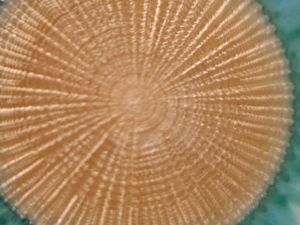
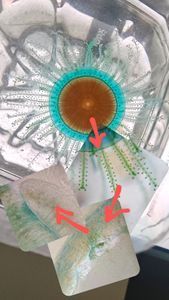
After returning from work at around 5 pm, I checked again. The brilliant blue and brown colors had faded, leaving just traces. It was beginning to lose its essence.
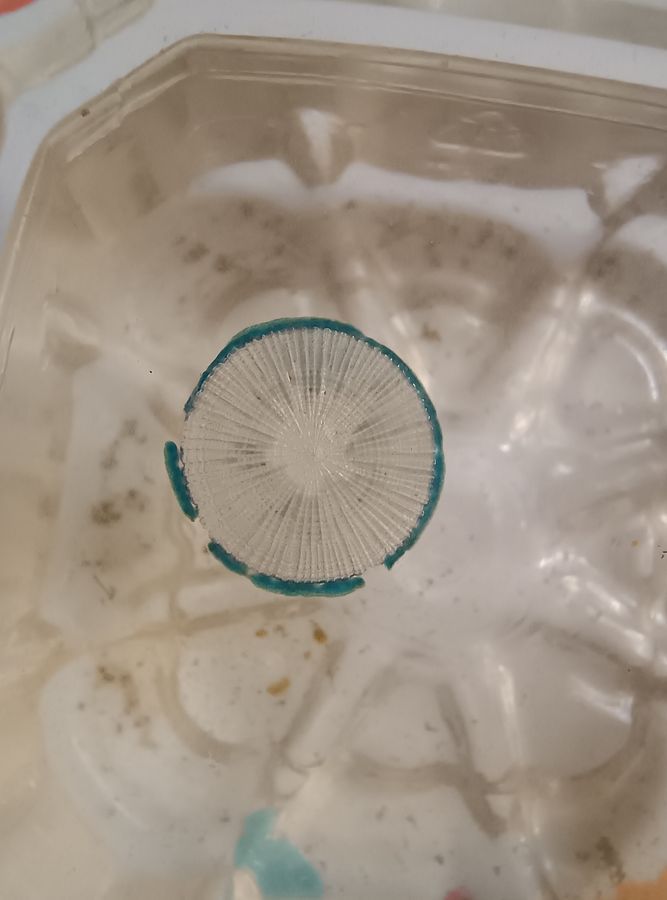
View in Media Gallery
The following morning, the transformation was complete—only a translucent white disc remained, silently floating in the water. The once-vibrant colony had almost disappeared, leaving behind a pale remnant of its previous life.

View in Media Gallery
The observation continues. I'm curious to see how long the disc remains intact, and what changes—if any—follow.
More updates to come as Sonali, Rupali, and Anu add their observations!
More updates to come as Sonali, Rupali, and Anu add their observations!
Sign in to commentNobody has commented yet... Share your thoughts with the author and start the discussion!

 0 Applause
 0 Comments