LGP25B3 - Nature's Brick Wall
 Jun 06, 2025 • 1:32 PM UTC
 India
India 340x Magnification
 Plants
Karthik Agarwal
Hi! I'm a student from India, currently studying in 10th grade (ICSE board).
9posts
4comments
0locations
View in Media Gallery
Onions occupy a vital position in our kitchens. These humble vegetables are a crucial part of dishes from cuisines across the world.
But if you ask any chef, they'll tell you that onion skins are quite annoying to deal with. At best, these skins will end up in a compost bin.
However, if you decide to instead preserve these skins and observe them under a Foldscope, you will get to witness a treat - n ature's very own brick wall, made of cells!
But if you ask any chef, they'll tell you that onion skins are quite annoying to deal with. At best, these skins will end up in a compost bin.
However, if you decide to instead preserve these skins and observe them under a Foldscope, you will get to witness a treat - n ature's very own brick wall, made of cells!

View in Media Gallery
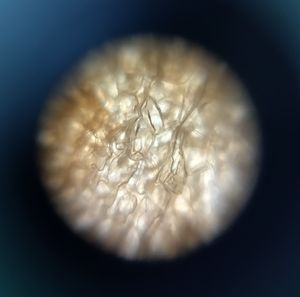
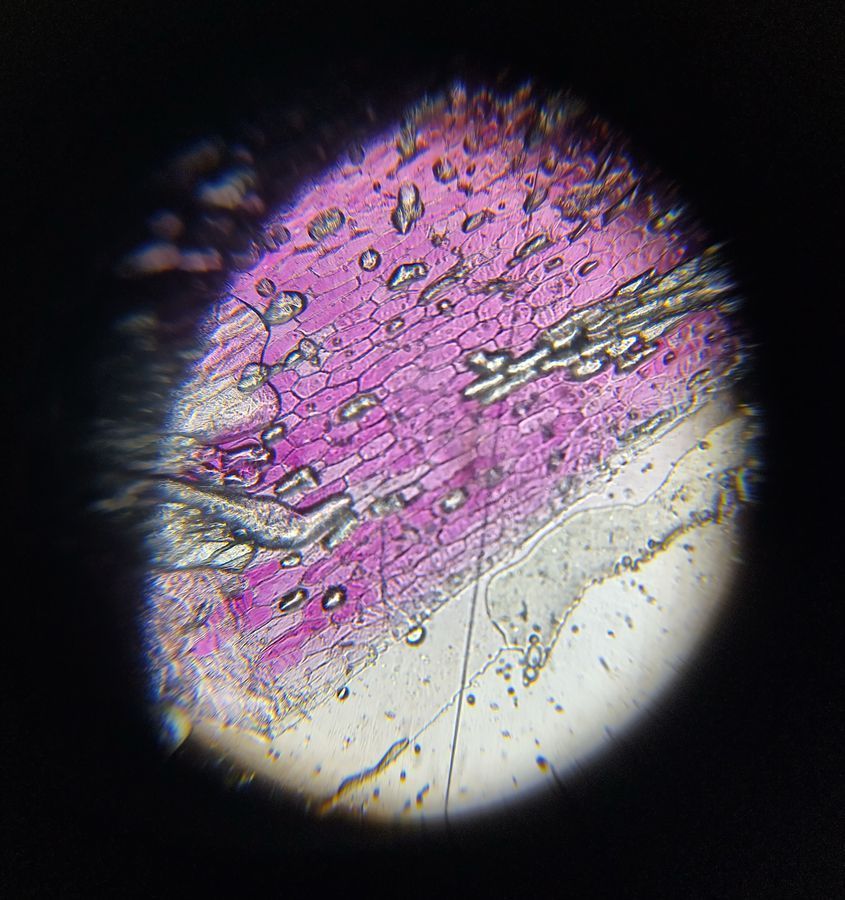
At 50X magnification, as seen in the picture above, you get a bird’s eye view of the brick wall of cells. We can see the elongated rectangular shape of the cells. The cells are packed together tightly with no intercellular spaces, giving the appearance of a brick wall. We can also see that the cell walls are thin and don’t have any thickenings. Water droplets moving on the surface are also visible, as well as some gum residue from the cellotape applied.

View in Media Gallery
At 140X magnification, we get a closer view of how the cells are connected to one another (cell connectivity). We got to observe that some cells are not rectangular, but hexagonal in shape. This is because hexagons fill the available shape efficiently and they are more mechanically stable than rectangles.

View in Media Gallery
At 340X magnification, we see crater-like depressions indicating the nuclei of the cells. The cytoplasm also looks more granular at this level instead of being visible as a plain color. In some cells, we can see the cell membrane distinguishable from the cell wall.
And that was a quick look at nature's brick wall - the humble onion skin!
And that was a quick look at nature's brick wall - the humble onion skin!
Sign in to commentNobody has commented yet... Share your thoughts with the author and start the discussion!

 0 Applause
 0 Comments