Nature's Hidden Jigsaw Puzzles!
 Oct 18, 2025 • 5:37 PM UTC
 India
India 340x Magnification
 Plants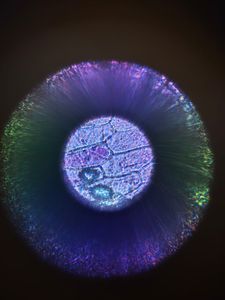
Karthik Agarwal
Hi! I'm a student from India, currently studying in 10th grade (ICSE board).
9posts
4comments
0locations

View in Media Gallery
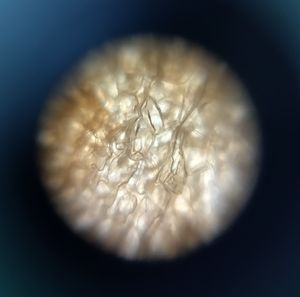
I wasn't expecting to see anything too interesting when I viewed the petal of a yellow tecoma flower under my Foldscope. Boy, was I wrong to think that.
What I saw was a beautiful jigsaw puzzle of cells, all with irregular and odd shapes that perfectly slotted into each other.
What I saw was a beautiful jigsaw puzzle of cells, all with irregular and odd shapes that perfectly slotted into each other.

View in Media Gallery
(above picture was taken at 140X)
My first thought was, "why?"
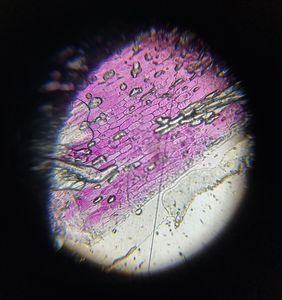
I instinctively thought that this seemed inefficient. After all, using regular shapes like hexagons is best for efficiently tiling a 2D plane, right? And that is indeed what other samples seem to suggest. Onion skin cells show regularity. Fern rhizome cells show regularity. Then why didn't these cells follow the same norm?
My first thought was, "why?"
I instinctively thought that this seemed inefficient. After all, using regular shapes like hexagons is best for efficiently tiling a 2D plane, right? And that is indeed what other samples seem to suggest. Onion skin cells show regularity. Fern rhizome cells show regularity. Then why didn't these cells follow the same norm?

View in Media Gallery
(above picture was taken at 140X with 2X camera magnification)
So, I started researching this phenomenon. This is the paper I found to be most helpful - https://doi.org/10.7554/eLife.32794
This is the gist of what I could gather from the paper -
The internal turgor pressure gives the non-woody plant tissue its shape. Without it, these plant parts like leaves and petals would wilt. The problem is that this pressure creates a lot of mechanical stress on the epidermal cell walls.
In roots and stems where the cells grow mostly in one direction, the problem of mechanical stress is sufficiently reduced by having long and thin cells. However, this strategy does not work in the plant parts that grow isotropically (uniformly in all directions) like leaves and petals. In these places, puzzle shaped cells are used.
The lobes and indentations of the puzzle shaped cells create more contact points between adjacent cells, and so, the force from turgor pressure gets distributed more evenly across the whole tissue.
This is also very resource efficient for the plant. Instead of spending resources on fortifying and strengthening the cell walls further, the plant cleverly uses jigsaw puzzle cells instead!
So, I started researching this phenomenon. This is the paper I found to be most helpful - https://doi.org/10.7554/eLife.32794
This is the gist of what I could gather from the paper -
The internal turgor pressure gives the non-woody plant tissue its shape. Without it, these plant parts like leaves and petals would wilt. The problem is that this pressure creates a lot of mechanical stress on the epidermal cell walls.
In roots and stems where the cells grow mostly in one direction, the problem of mechanical stress is sufficiently reduced by having long and thin cells. However, this strategy does not work in the plant parts that grow isotropically (uniformly in all directions) like leaves and petals. In these places, puzzle shaped cells are used.
The lobes and indentations of the puzzle shaped cells create more contact points between adjacent cells, and so, the force from turgor pressure gets distributed more evenly across the whole tissue.
This is also very resource efficient for the plant. Instead of spending resources on fortifying and strengthening the cell walls further, the plant cleverly uses jigsaw puzzle cells instead!

View in Media Gallery
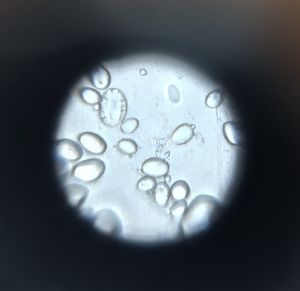
(above picture was taken at 340X)
For more context - I used a very thin slice of a petal of yellow tecoma flower as my sample to get these images. I stuck the petal to a piece of sticky tape and then peeled it off quickly to get a thin layer of cells on the tape, which I then viewed under the Foldscope :)
For more context - I used a very thin slice of a petal of yellow tecoma flower as my sample to get these images. I stuck the petal to a piece of sticky tape and then peeled it off quickly to get a thin layer of cells on the tape, which I then viewed under the Foldscope :)
Sign in to commentNobody has commented yet... Share your thoughts with the author and start the discussion!
 0 Applause
 0 Comments