LGP26-B3 Fern Anatomy Under the Foldscope
 Jun 02, 2026 • 10:09 AM UTC
 8CRJ4CW3+P7
 340x Magnification
 Plants
Shravya Mohabey
Learn about the author...
4posts
0comments
0locations
View in Media Gallery
When I first placed the fern rhizome cross section under my Foldscope, I expected to see only random plant cells. Instead, I discovered an organised microscopic world filled with patterns, colours, and structures that looked almost artistic. Using the Foldscope and exploring observations on Microcosmos helped me realise how much complexity exists inside something as ordinary as a fern.
The fern rhizome is an underground stem that helps in storage, support, and transport within the plant. By observing its cross section, I was able to explore different tissues and understand how plants are internally structured.
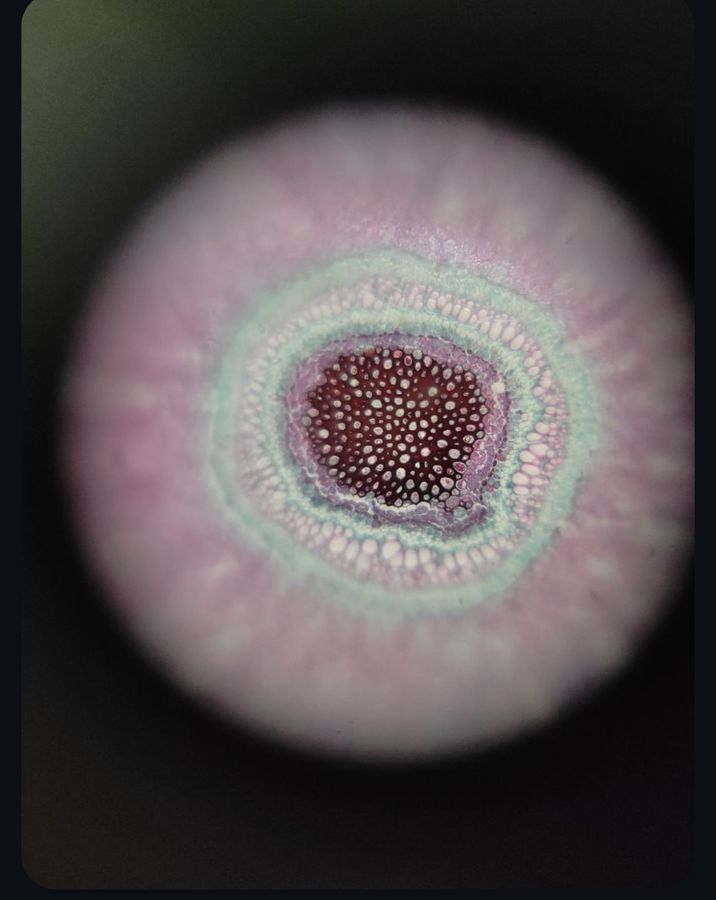
At lower magnification, the fern rhizome appeared as a circular structure with different coloured regions. Some areas were darker and densely packed, while others appeared lighter and more spread out. The stained sample showed contrasting bands of pink, blue, and purple, making different tissues easier to identify.
The fern rhizome is an underground stem that helps in storage, support, and transport within the plant. By observing its cross section, I was able to explore different tissues and understand how plants are internally structured.
At lower magnification, the fern rhizome appeared as a circular structure with different coloured regions. Some areas were darker and densely packed, while others appeared lighter and more spread out. The stained sample showed contrasting bands of pink, blue, and purple, making different tissues easier to identify.

View in Media Gallery
At medium magnification, the internal arrangement became clearer. I could observe groups of cells organised around a darker central region. The vascular tissue stood out prominently and appeared almost like a sideways figure eight. Surrounding tissues contained thinner and loosely packed cells.

View in Media Gallery
At higher magnification, individual cell structures became more visible. Some cells appeared thick-walled and compact, while others were thin-walled and rounded. The detailed patterns made the rhizome look surprisingly organised and complex.

View in Media Gallery
This observation changed the way I look at plants. Before using the Foldscope, I never imagined that a fern rhizome would contain such detailed and organised structures. The experience made microscopy feel less like memorising diagrams and more like exploring a hidden world.
Sign in to commentNobody has commented yet... Share your thoughts with the author and start the discussion!
 0 Applause
 0 Comments
