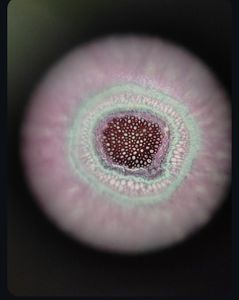
LGP26B3- Microarchitecture of an onion peel
 Jun 03, 2026 • 7:02 AM UTC
 India
India 340x Magnification
 Plants
Shravya Mohabey
Learn about the author...
4posts
0comments
0locations

View in Media Gallery
I didn’t expect an onion peel to be interesting. It was just something from my kitchen, the kind of thing you chop without thinking twice and immediately regret when your eyes start betraying you.
But when I placed the thin onion peel under my Foldscope 2.0, it stopped being “just an onion” and turned into something unexpectedly structured. I wasn’t even sure what I was looking for at first, I just knew I wanted to see what it looked like at a microscopic level.
I wasn’t using any stain, so I expected everything to look faint or unclear. It did look subtle, but the structure was still surprisingly visible.
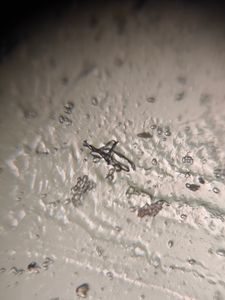
At low magnification, the onion peel appeared as a thin, almost transparent sheet. At first glance, it didn’t look like much—just a faint layer floating under the lens.
As I focused more carefully, I could make out a pattern of tightly packed rectangular cells. They looked like small compartments arranged side by side, forming a continuous sheet. Even without staining, the cell walls were visible as fine outlines.
But when I placed the thin onion peel under my Foldscope 2.0, it stopped being “just an onion” and turned into something unexpectedly structured. I wasn’t even sure what I was looking for at first, I just knew I wanted to see what it looked like at a microscopic level.
I wasn’t using any stain, so I expected everything to look faint or unclear. It did look subtle, but the structure was still surprisingly visible.
At low magnification, the onion peel appeared as a thin, almost transparent sheet. At first glance, it didn’t look like much—just a faint layer floating under the lens.
As I focused more carefully, I could make out a pattern of tightly packed rectangular cells. They looked like small compartments arranged side by side, forming a continuous sheet. Even without staining, the cell walls were visible as fine outlines.

View in Media Gallery
At higher focus, the structure became clearer. The cells were uniform in shape, and I could notice small darker regions in some cells, which likely represented the nucleus. Most of the cell interior looked pale and empty due to the large central vacuole, even though it wasn’t strongly visible without stain.

View in Media Gallery
The overall pattern looked strangely organised, almost like a tiled surface designed with precision.
What surprised me wasn’t just what I saw, but how something so ordinary could have such a structured internal design. An onion is something I see daily, but I had never thought about what its surface actually looks like at a cellular level.
Using the Foldscope 2.0 made the experience feel simple but eye-opening. Even without staining or advanced lab setup, the basic structure of plant cells was still visible if you paid attention.
It made me realise that science isn’t always about complicated equipment. Sometimes it’s just about looking at normal things properly instead of ignoring them.
What surprised me wasn’t just what I saw, but how something so ordinary could have such a structured internal design. An onion is something I see daily, but I had never thought about what its surface actually looks like at a cellular level.
Using the Foldscope 2.0 made the experience feel simple but eye-opening. Even without staining or advanced lab setup, the basic structure of plant cells was still visible if you paid attention.
It made me realise that science isn’t always about complicated equipment. Sometimes it’s just about looking at normal things properly instead of ignoring them.
Sign in to commentNobody has commented yet... Share your thoughts with the author and start the discussion!
 0 Applause
 0 Comments