LGP26-B3 Inside a potato flesh
 Jun 03, 2026 • 9:02 AM UTC
 India
India 340x Magnification
 Plants
Shravya Mohabey
Learn about the author...
4posts
0comments
0locations
View in Media Gallery
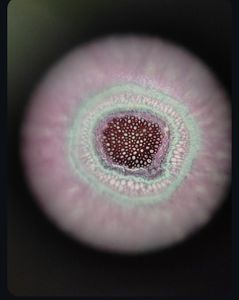
I didn’t expect much from potato flesh. It’s something I see all the time in food, but I had never thought about what it looks like at a microscopic level.
When I placed a thin section of potato tissue under my Foldscope 2.0, I expected a soft, unclear structure. Even though I didn’t use any stain, I still wanted to see if I could make out any cellular patterns.
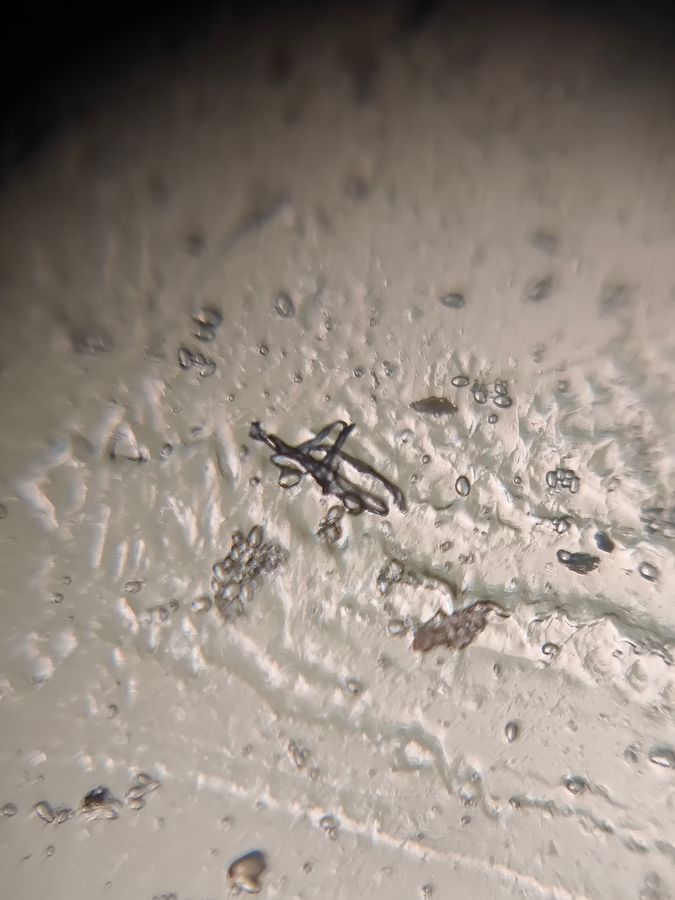
At low magnification, the potato flesh looked like a pale, slightly grainy mass. It didn’t have sharp or obvious structures at first, which made it a bit difficult to interpret.
As I slowly adjusted the focus, faint cell boundaries started appearing. The cells were irregularly shaped, mostly oval to round, and loosely arranged compared to something like onion peel. The overall structure looked soft and less organised, but still clearly cellular.
However, it wasn’t very easy to interpret what I was seeing. One of the main difficulties was distinguishing actual cells from air bubbles and small patches of tape or glue from the slide preparation. Air bubbles often looked like perfect circular “cells,” and some adhesive marks created unclear shapes that confused the view.
With careful focusing, I could separate the more consistent patterns of cell walls from these distortions. Inside some cells, slightly denser regions were visible, likely related to stored material. Even with these challenges, the tissue still showed clear plant cell organisation.
What stood out to me was not just the structure of the potato tissue, but how messy real microscopic observation can be. The images in textbooks always look clean and perfectly labelled, but in reality, it takes time to figure out what is actually a cell and what is just an artifact like an air bubble or leftover adhesive.
This experience made me more careful and patient while observing samples. The Foldscope 2.0 made it possible to explore biological structures easily, but it also showed that interpreting what you see is just as important as seeing it in the first place.
It also helped me understand that plant tissues vary a lot depending on their function. Compared to the tightly packed onion epidermis, potato tissue looked much more irregular, which makes sense since it mainly serves as a storage organ.
When I placed a thin section of potato tissue under my Foldscope 2.0, I expected a soft, unclear structure. Even though I didn’t use any stain, I still wanted to see if I could make out any cellular patterns.
At low magnification, the potato flesh looked like a pale, slightly grainy mass. It didn’t have sharp or obvious structures at first, which made it a bit difficult to interpret.
As I slowly adjusted the focus, faint cell boundaries started appearing. The cells were irregularly shaped, mostly oval to round, and loosely arranged compared to something like onion peel. The overall structure looked soft and less organised, but still clearly cellular.
However, it wasn’t very easy to interpret what I was seeing. One of the main difficulties was distinguishing actual cells from air bubbles and small patches of tape or glue from the slide preparation. Air bubbles often looked like perfect circular “cells,” and some adhesive marks created unclear shapes that confused the view.
With careful focusing, I could separate the more consistent patterns of cell walls from these distortions. Inside some cells, slightly denser regions were visible, likely related to stored material. Even with these challenges, the tissue still showed clear plant cell organisation.
What stood out to me was not just the structure of the potato tissue, but how messy real microscopic observation can be. The images in textbooks always look clean and perfectly labelled, but in reality, it takes time to figure out what is actually a cell and what is just an artifact like an air bubble or leftover adhesive.
This experience made me more careful and patient while observing samples. The Foldscope 2.0 made it possible to explore biological structures easily, but it also showed that interpreting what you see is just as important as seeing it in the first place.
It also helped me understand that plant tissues vary a lot depending on their function. Compared to the tightly packed onion epidermis, potato tissue looked much more irregular, which makes sense since it mainly serves as a storage organ.
Sign in to commentNobody has commented yet... Share your thoughts with the author and start the discussion!

 0 Applause
 0 Comments