Pollen Grains through the foldscope at LGP26-B3
 Jun 04, 2026 • 8:17 AM UTC
 India
India 340x Magnification
 Plants
Ishit001
Average Foldscope user
6posts
0comments
0locations
View in Media Gallery
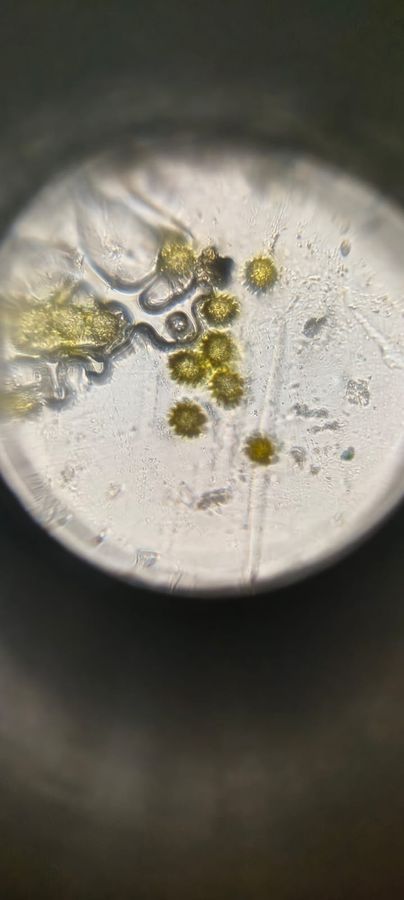
Observing pollen grains through the foldscope at 50x, 140x & 340x.
Preparing the slide: I took a sunflower and stuck a piece of cello-tape near its pollen sacs a few times and then carefully put this tape on the glass slide. I got 1-2 pollen sacs as well which made it easier to locate pollens as there were many pollens near the sacs.
Difficulties: there were a few difficulties in the process, out of which the biggest issue was searching for pollen grains. the grains are very small and hardly visible on 50x. I had to go to 140x to position them accurately (50x suffices for just roughly locating them, by referring to a pollen sac, which can be seen easily). Another difficulty was sampling properly, as on the first attempt (with hibiscus) I was not able to sample any pollen even after trying a few times.
Images:
Preparing the slide: I took a sunflower and stuck a piece of cello-tape near its pollen sacs a few times and then carefully put this tape on the glass slide. I got 1-2 pollen sacs as well which made it easier to locate pollens as there were many pollens near the sacs.
Difficulties: there were a few difficulties in the process, out of which the biggest issue was searching for pollen grains. the grains are very small and hardly visible on 50x. I had to go to 140x to position them accurately (50x suffices for just roughly locating them, by referring to a pollen sac, which can be seen easily). Another difficulty was sampling properly, as on the first attempt (with hibiscus) I was not able to sample any pollen even after trying a few times.
Images:

View in Media Gallery
Observations: on 50x, we can see a small dot of yellow material surrounded by a wall of dotted cells (I am not fully sure if they are cells or just air bubbles, or some other artifact). On 140x, I zoomed into this region and then some pollen were observable as circular yellow colored bodies. A pollen sac can also be seen near the pollen. The fine structures of the pollen only start becoming visible on 340x. Now, the spikes on the pollen were visible. Using dark-field microscopy, these could be further enhanced but I could not try that unfortunately.
Sign in to commentNobody has commented yet... Share your thoughts with the author and start the discussion!

 0 Applause
 0 Comments
_300x300.jpeg)
_300x300.jpeg)

