Going Back to Roots: Why You Should Draw What You See Through a Microscope
 Oct 15, 2024 • 4:55 PM UTC
 India
India 140x Magnification
 Information
Dr Rafikh Shaikh
I'm a science educator interested in everything science.
115posts
91comments
20locations
View in Media Gallery
A few days ago, I turned to drawing as a way to reduce my phone use. At first, I sketched random things, but soon I shifted my focus to a subject that has long fascinated me—microscopic objects seen through a Foldscope.
As I started drawing these intricate details, I had several realizations. In this post, I’ll share my thoughts on why drawing, rather than just taking photos or videos, is an invaluable method for scientific exploration.
1. A Historical Perspective
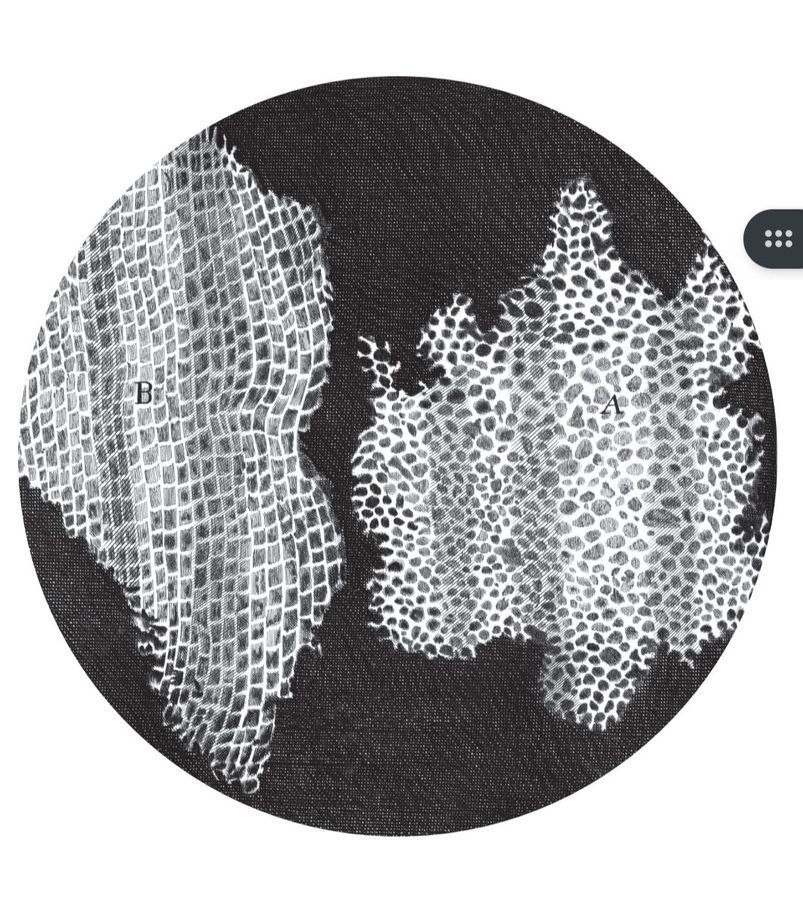
When microscopes first opened up a hidden world, biologists didn’t have the luxury of cameras. Instead, they turned to pen and paper to document what they saw. For instance, Robert Hooke’s book Micrographia contains detailed drawings based on his microscopic observations. Similarly, Antonie van Leeuwenhoek meticulously sketched what he viewed under his microscope.
As I started drawing these intricate details, I had several realizations. In this post, I’ll share my thoughts on why drawing, rather than just taking photos or videos, is an invaluable method for scientific exploration.
1. A Historical Perspective
When microscopes first opened up a hidden world, biologists didn’t have the luxury of cameras. Instead, they turned to pen and paper to document what they saw. For instance, Robert Hooke’s book Micrographia contains detailed drawings based on his microscopic observations. Similarly, Antonie van Leeuwenhoek meticulously sketched what he viewed under his microscope.
View in Media Gallery
These early scientists had no choice but to draw, as it was the only method to document their findings. But I believe this practice had unintended benefits. Drawing helped them notice the finer details of their subjects—the spatial arrangements, connections, and structures that might be overlooked in a photograph. When we draw, we engage in a form of modeling, creating a representation of the object that forces us to study it from multiple angles. In contrast, a photo can make us passive observers, more likely to miss such subtleties.
2. Drawing as a Model for Understanding
In my own experience of drawing microscopic objects through the Foldscope, I noticed that I observed things I had missed even when I had already photographed them. The act of drawing encouraged me to think about how the object was oriented, what angle I was viewing it from, and how its parts were connected.
Drawing is essentially a process of transforming a 3D object into a 2D representation. This transformation forces us to focus on specific sides of the object in different drawings, helping us construct a mental 360-degree view. The deeper I got into the drawing process, the more I realized I was truly seeing these objects for the first time—details that simply weren’t visible in the photos became clear.
3. Pointillism as a Scientific Drawing Technique
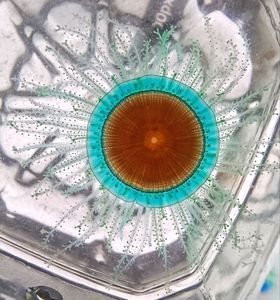
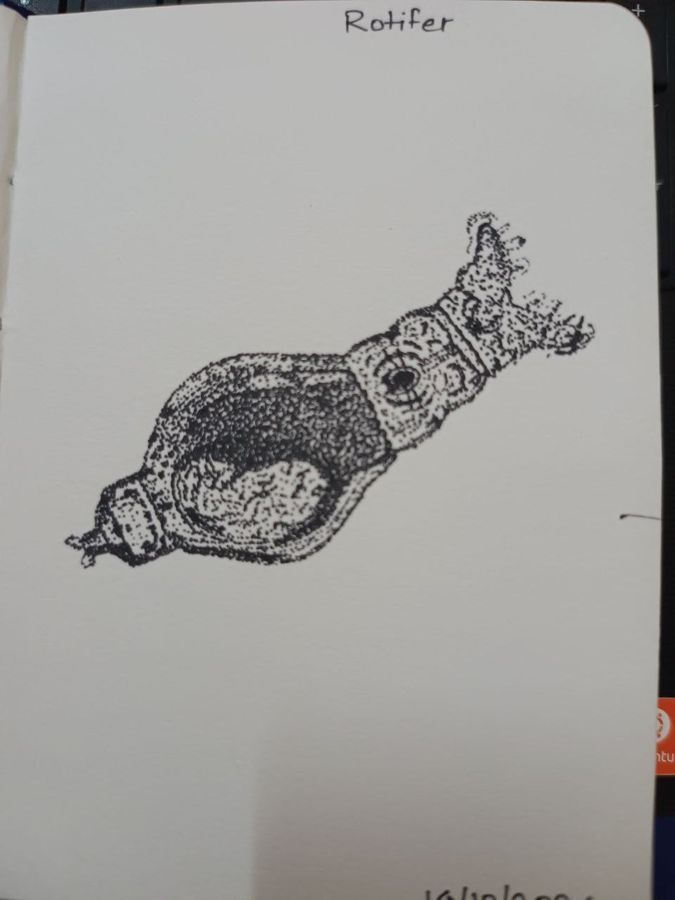
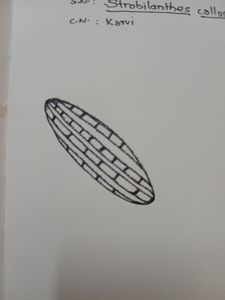
The technique I’ve been using is called pointillism, or stippling, where you place tiny dots of ink on paper to create an image. Here’s a drawing I made of a rotifer I saw under the Foldscope.
2. Drawing as a Model for Understanding
In my own experience of drawing microscopic objects through the Foldscope, I noticed that I observed things I had missed even when I had already photographed them. The act of drawing encouraged me to think about how the object was oriented, what angle I was viewing it from, and how its parts were connected.
Drawing is essentially a process of transforming a 3D object into a 2D representation. This transformation forces us to focus on specific sides of the object in different drawings, helping us construct a mental 360-degree view. The deeper I got into the drawing process, the more I realized I was truly seeing these objects for the first time—details that simply weren’t visible in the photos became clear.
3. Pointillism as a Scientific Drawing Technique
The technique I’ve been using is called pointillism, or stippling, where you place tiny dots of ink on paper to create an image. Here’s a drawing I made of a rotifer I saw under the Foldscope.


I found stippling to be a particularly effective method for scientific drawing. It offers a high degree of control and allows you to capture minute details. Not only that, but the end result is often visually striking—a balance between scientific accuracy and aesthetic appeal.
(Following are some of my drawings, you see my progress, see images from the bottom to top)
(Following are some of my drawings, you see my progress, see images from the bottom to top)



4. The Value of Drawing in the Digital Age
Even in today’s world, where phones and cameras allow us to capture everything effortlessly, I believe there’s value in going back to the basics. Drawing forces us to slow down, pay attention, and truly understand what we’re observing under the microscope—just like the early microbiologists did.
So, the next time you peer through a microscope, consider putting down the camera and picking up a pen. You might be surprised at how much more you see.
Even in today’s world, where phones and cameras allow us to capture everything effortlessly, I believe there’s value in going back to the basics. Drawing forces us to slow down, pay attention, and truly understand what we’re observing under the microscope—just like the early microbiologists did.
So, the next time you peer through a microscope, consider putting down the camera and picking up a pen. You might be surprised at how much more you see.
Sign in to commentNobody has commented yet... Share your thoughts with the author and start the discussion!

 0 Applause
 0 Comments