LGP 26 - Day 1 - Fern Rhizome
 Jun 10, 2026 • 12:25 PM UTC
 CPQV2V6M+Q3
 140x Magnification
 Plants
Saloni Buradkar
Learn about the author...
5posts
0comments
0locations

Wow ! What an amazing adventure !
Today wasn't just a deep dive into the world of microscopy, but my first interaction and introduction to a revolutionary tool - The Foldscope - a paper folding microscope that's portable and easy to use invented by Dr. Manu Prakash and Jim Cybulski.
Our day started off with a simple questionnaire that invited us to ask ourselves an important question - How do we know something is true if we don't investigate it ?
And I truly resonate with this question because of my interest in law and sciences - both things that rely heavily on evidence, proof, curiosity and questioning.
We discussed about the common practise of consuming medicines when we have a fever, without knowing the root cause behind the fever. We discussed the different kinds of microbes and debated upon anti-microbial resistance being a huge issue.
We then got our Foldscope 2.0 Kits and it was very exciting to see the various components in it that we would be using over the course of the following week, and way beyond that for exploring the microscopic world around us.
We started off our microscoping journey by observing the sample slide that was provided to us within the kit itself - The Fern Rhizome.
It was beautifully prepared and pigmented to allow us to see the various cells, and its overall structure with ease.
I started off by inserting the slide into the foldscope, and I used the 50x lens first, unsure at first of how things would be as I had never used a microscope before. And moments later I was definitely blown away by how the cells looked.
Today wasn't just a deep dive into the world of microscopy, but my first interaction and introduction to a revolutionary tool - The Foldscope - a paper folding microscope that's portable and easy to use invented by Dr. Manu Prakash and Jim Cybulski.
Our day started off with a simple questionnaire that invited us to ask ourselves an important question - How do we know something is true if we don't investigate it ?
And I truly resonate with this question because of my interest in law and sciences - both things that rely heavily on evidence, proof, curiosity and questioning.
We discussed about the common practise of consuming medicines when we have a fever, without knowing the root cause behind the fever. We discussed the different kinds of microbes and debated upon anti-microbial resistance being a huge issue.
We then got our Foldscope 2.0 Kits and it was very exciting to see the various components in it that we would be using over the course of the following week, and way beyond that for exploring the microscopic world around us.
We started off our microscoping journey by observing the sample slide that was provided to us within the kit itself - The Fern Rhizome.
It was beautifully prepared and pigmented to allow us to see the various cells, and its overall structure with ease.
I started off by inserting the slide into the foldscope, and I used the 50x lens first, unsure at first of how things would be as I had never used a microscope before. And moments later I was definitely blown away by how the cells looked.

View in Media Gallery
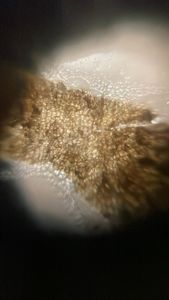
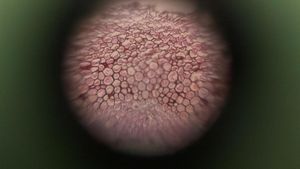
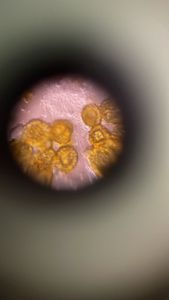
I wasn't able to get a very clear picture, but what I saw through the foldscope was more than enough to blow my mind. You could see the various rings of cells from the cross section of the stem (rhizome) and the pith, xylem and phloem, in perfect circular rings that reminded me of the cross section of tree trunks.


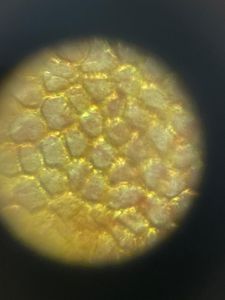
These pictures were taken using the 140x lens, and are of the central pith and outer most ring. My friend mentioned that using this lens the central pith reminded her of pomegranates. As the cells were further enlarged as the power of the lens was increased, you could observe each individual cell wall and their hexagonal yet compacted structure.


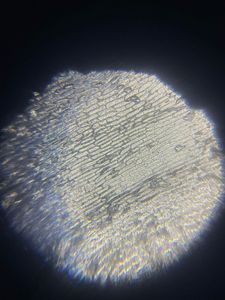
When I increased the power of the lens to 340x, apparently the pigment didn't seem as vibrant anymore, and it seemed paler, although the cell structure was still visible. The last picture really reminded me of the moon because of not just because of the pale colour, but due to the ambiguity of the structure of the cells in that part.
And my favourite picture using the 340x lens is...
And my favourite picture using the 340x lens is...

View in Media Gallery
THIS picture.
We decided to experiment by using our phone flashlight below the foldscope and click the picture. It looks like a disco party to be honest within each cell, as the light refracts and the pigment combined, gives it a multi-colour look.
I enjoyed today's lecture so much, and there was still another sample planned for today - Onion Cells - which I have written another blog post about.
This introduction to this revolutionary tool, and my first time looking at a sample, that too one such beautifully pigmented, truly revolutionised my perspective, and increased my sense of curiosity and wonder.
I have learnt that although we think discovery is all about discovering phenomenon and proving theories about the big wide world around us, like the mystery of the massive universe we live it, that we often forget to peer into the tiny world already existing around us that we often overlook.
And this exploration of the tiny, yet amazing world around us, will continue, with guidance by my wonderful course professor Dr. Anupma Harshal.
We decided to experiment by using our phone flashlight below the foldscope and click the picture. It looks like a disco party to be honest within each cell, as the light refracts and the pigment combined, gives it a multi-colour look.
I enjoyed today's lecture so much, and there was still another sample planned for today - Onion Cells - which I have written another blog post about.
This introduction to this revolutionary tool, and my first time looking at a sample, that too one such beautifully pigmented, truly revolutionised my perspective, and increased my sense of curiosity and wonder.
I have learnt that although we think discovery is all about discovering phenomenon and proving theories about the big wide world around us, like the mystery of the massive universe we live it, that we often forget to peer into the tiny world already existing around us that we often overlook.
And this exploration of the tiny, yet amazing world around us, will continue, with guidance by my wonderful course professor Dr. Anupma Harshal.
Sign in to commentNobody has commented yet... Share your thoughts with the author and start the discussion!
 0 Applause
 0 Comments