LGP 26 - Day 2 - Potato Peels and Flesh
 Jun 11, 2026 • 7:42 AM UTC
 CMPMQGXR+R3
 140x Magnification
 Plants
Saloni Buradkar
Learn about the author...
5posts
0comments
0locations
View in Media Gallery
Today, the first sample we would be exploring using the foldscope was a potato sample. I was honestly quite curious to see how it would look like under the lens, seeing how rough its exterior is in comparison to its smooth interior flesh.
We started off by receiving small potato chunks and peeling off the potato peel from them. This was slightly difficult, as the peel would break off while peeling and you wouldn't get a proper sample, and for others their flesh got peeled off alongside too. But we all remembered not to be greedy and take too much for sampling, as it is the potato peel was already slightly thick.
I prepared two slides in fact, with two different pieces of the peel from different regions of the potato. I was interested in seeing if the peels would look different, or would their composition be the same.
I started off by observing my slides using the 50x lens.
We started off by receiving small potato chunks and peeling off the potato peel from them. This was slightly difficult, as the peel would break off while peeling and you wouldn't get a proper sample, and for others their flesh got peeled off alongside too. But we all remembered not to be greedy and take too much for sampling, as it is the potato peel was already slightly thick.
I prepared two slides in fact, with two different pieces of the peel from different regions of the potato. I was interested in seeing if the peels would look different, or would their composition be the same.
I started off by observing my slides using the 50x lens.

View in Media Gallery
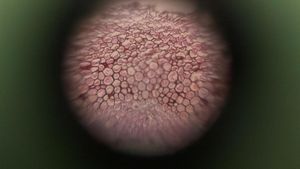
This is one of my favourite pictures using the 50x lens. Here you can see the compact structure of the potato cells in the peel, and how beautifully they glimmer when light passes through them giving them that earthy brown colour. This was quite interesting as when we had observed the peel of the tomato, it was yellowish in colour and didn't have the same colouring as how we perceive it normally - a red fruit. Whereas here, it reflected the colour of the potato the way we normally see it - brown. The cells here seem to be circular, and you can observe darker and lighter bits of brown quite easily.
Next, we moved on to the 140x lens, using which I took quite a lot of pictures.
Next, we moved on to the 140x lens, using which I took quite a lot of pictures.


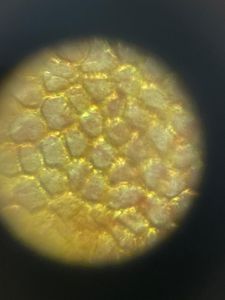
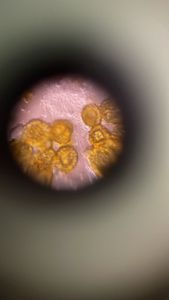
In these pictures, one thing that stood out to me, was the resemblance of the sample under this lens to metals like copper and gold, especially colour wise. This may be due to the lighting used while making these observations of taking these pictures, but it was a striking resemblance I couldn't ignore. I even showed my findings to my friends, who agreed with me too !
Here, you can observe the cell structure more clearly, with defined boundaries, how the lighting affects the look of the cell's pigmentation, and what appears to be slightly raised bumps of cell mass, that might be thicker in some areas of the peel, perhaps giving it that rough texture I mentioned earlier.
Now I moved on to the 340x lens. I wanted to see if the "metal" like appearance would be further visible here too and inspect the cell structure even more.
Here, you can observe the cell structure more clearly, with defined boundaries, how the lighting affects the look of the cell's pigmentation, and what appears to be slightly raised bumps of cell mass, that might be thicker in some areas of the peel, perhaps giving it that rough texture I mentioned earlier.
Now I moved on to the 340x lens. I wanted to see if the "metal" like appearance would be further visible here too and inspect the cell structure even more.


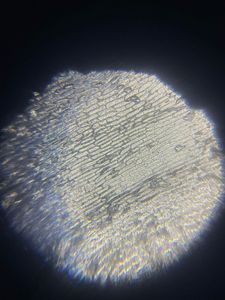
Here, the cells appeared way darker, almost greyish, again this could be due to lighting. You could see smaller circular cells attached to bigger more oval-like cells, with very well-defined boundaries. Based upon my research, the peel is a protective tissue and is thus made of thick-walled cells, to prevent water loss and protect against pathogens.
We were now told to observe the potato flesh using the foldscope. But before that, we were asked a question - How would you sample the flesh? Some of us said to cut it into very thin slices, others said to rub it against the slide, some said to mash it up and use it. In the end, we came to the conclusion, that we must keep in mind the frugality of the tool and work with what we have, namely our hands. So, we decided to mash it lightly after placing a small piece of the flesh on the slide, and remove the excess, ensuring that we had just enough of the sample on our slides.
We then observed the potato flesh through the 140x lens.
We were now told to observe the potato flesh using the foldscope. But before that, we were asked a question - How would you sample the flesh? Some of us said to cut it into very thin slices, others said to rub it against the slide, some said to mash it up and use it. In the end, we came to the conclusion, that we must keep in mind the frugality of the tool and work with what we have, namely our hands. So, we decided to mash it lightly after placing a small piece of the flesh on the slide, and remove the excess, ensuring that we had just enough of the sample on our slides.
We then observed the potato flesh through the 140x lens.


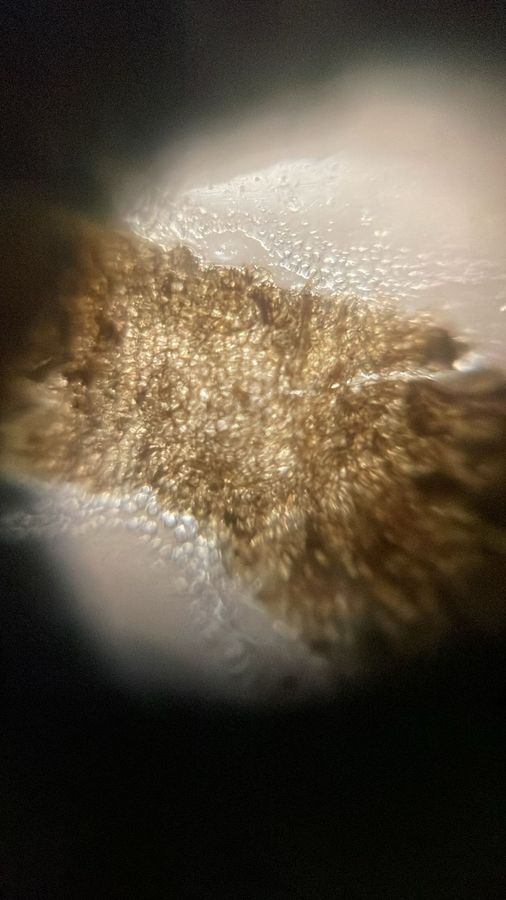
Here you could observe big clusters of transparent cells, that were well-defined. They were circular and you could see darker dots within some of the cells too, which was perhaps starch. It would be more visible with higher magnification.
Oops ! I forgot to show you how it looked like under the 50x lens. Here you could see the massive extent of the transparent clusters, which were in various shapes.
Oops ! I forgot to show you how it looked like under the 50x lens. Here you could see the massive extent of the transparent clusters, which were in various shapes.


Now it was time for the 340x lens.


Here, you could see each individual cell with astonishing clarity. You could even see the starch granules ! You could easily observe the various sizes of the cells and the varying compacity of the potato flesh cells. In some areas they were small and packed tightly, whereas in others they were bigger and dispersed loosely.
Overall, it was very fun to see how this powerhouse of starch and an integral part of cooking worldwide, looked through a microscope.
Did you know that the potato was actually a nutritional superhero ? After being introduced to Europe from the Andes in the 1500s, this reliable food source essentially fueled a massive demographic boom in places like Prussia, France, and Ireland during the 17th and 18th centuries. This was because potatoes produce more calories per acre than other cereal crops, thus making them the optimal choice for a survival crop in a time plagued with droughts and famines. They even appeased the peasants, as their tuber nature and underground growth, ensured they couldn't be burned or seized by armies, and could be dug out as and when needed. The potato's incredible success led to over-reliance, thus causing The Irish Potato Famine in 1845, because impoverished Irish tenant farmers relied almost entirely on a single variety of potato for sustenance. When the arrival of a devastating fungus ( Phytophthora infestans ) wiped out the crop, then the results were devastatingly catastrophic.
Did you ever think that a vegetable we eat almost daily could impact our lives in such a huge way !
And apart from the big wide world around us, it impacts us the most on small levels every single day, in minuscule things we often ignore. This is why it's important to understand the world around us, and turn the unknown into the known, no matter how big or small it is.
Overall, it was very fun to see how this powerhouse of starch and an integral part of cooking worldwide, looked through a microscope.
Did you know that the potato was actually a nutritional superhero ? After being introduced to Europe from the Andes in the 1500s, this reliable food source essentially fueled a massive demographic boom in places like Prussia, France, and Ireland during the 17th and 18th centuries. This was because potatoes produce more calories per acre than other cereal crops, thus making them the optimal choice for a survival crop in a time plagued with droughts and famines. They even appeased the peasants, as their tuber nature and underground growth, ensured they couldn't be burned or seized by armies, and could be dug out as and when needed. The potato's incredible success led to over-reliance, thus causing The Irish Potato Famine in 1845, because impoverished Irish tenant farmers relied almost entirely on a single variety of potato for sustenance. When the arrival of a devastating fungus ( Phytophthora infestans ) wiped out the crop, then the results were devastatingly catastrophic.
Did you ever think that a vegetable we eat almost daily could impact our lives in such a huge way !
And apart from the big wide world around us, it impacts us the most on small levels every single day, in minuscule things we often ignore. This is why it's important to understand the world around us, and turn the unknown into the known, no matter how big or small it is.
Sign in to commentNobody has commented yet... Share your thoughts with the author and start the discussion!
 0 Applause
 0 Comments