LGP 26 - Day 2 - Tomato Skin
 Jun 10, 2026 • 4:55 PM UTC
 India
India 140x Magnification
 Plants
Saloni Buradkar
Learn about the author...
5posts
0comments
0locations
View in Media Gallery
The second sample we would be preparing today was of Tomatoes, something we ate almost on a daily basis, that would soon transport us to an entirely new world.
We received our tomato pieces and slowly began to dissect them by peeling of the thin layer of Tomato Skin and placing the delicate peel onto the slide. Some of my friends accidentally placed the red flesh along with the vibrant red-orange skin and had to redo their slides, while others ended up putting too big of a sample.
One thing we learn as a kid when it comes to morals is to never be greedy, and here we were introduced to the scientific reasoning behind it, at least in the context of Foldscope and Sample Observations. If you put too much of something on the slide to sample, you would end up with too many cells, or multiple layers of cells, which would both make the sample bulky and give you incorrect observations. Thus, when we were preparing our samples, our professor, Dr. Anupma Harshal, kept on telling us not to be greedy with our samples. It made some of us chuckle a bit, but we soon realised the reason why she said so, when our observations appeared so unclear and obscure. Because in science, just like life, excess often clouds the truth.
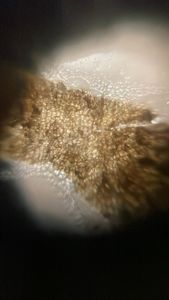
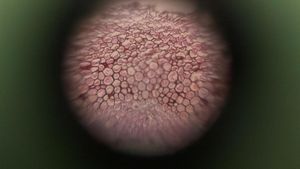
I started off by preparing my first slide for the Tomato Skin, and observed it under three lenses - 50x, 140x and 340x.
These are pictures of the Tomato Skin using the 50x lens.
We received our tomato pieces and slowly began to dissect them by peeling of the thin layer of Tomato Skin and placing the delicate peel onto the slide. Some of my friends accidentally placed the red flesh along with the vibrant red-orange skin and had to redo their slides, while others ended up putting too big of a sample.
One thing we learn as a kid when it comes to morals is to never be greedy, and here we were introduced to the scientific reasoning behind it, at least in the context of Foldscope and Sample Observations. If you put too much of something on the slide to sample, you would end up with too many cells, or multiple layers of cells, which would both make the sample bulky and give you incorrect observations. Thus, when we were preparing our samples, our professor, Dr. Anupma Harshal, kept on telling us not to be greedy with our samples. It made some of us chuckle a bit, but we soon realised the reason why she said so, when our observations appeared so unclear and obscure. Because in science, just like life, excess often clouds the truth.
I started off by preparing my first slide for the Tomato Skin, and observed it under three lenses - 50x, 140x and 340x.
These are pictures of the Tomato Skin using the 50x lens.


Here, you can really see how compactly the cells are arranged, and their circular nature, with their well-defined cell boundaries. They mainly appear to be yellow, with traces of orange too, but unlike the whole tomato we see normally with our eyes, we never observed a deep red hue. The cells seemed to be quite small, and the dot like structure reminded me of an art style called pointillism. Perhaps you could say that the tomato was nature's work of art.
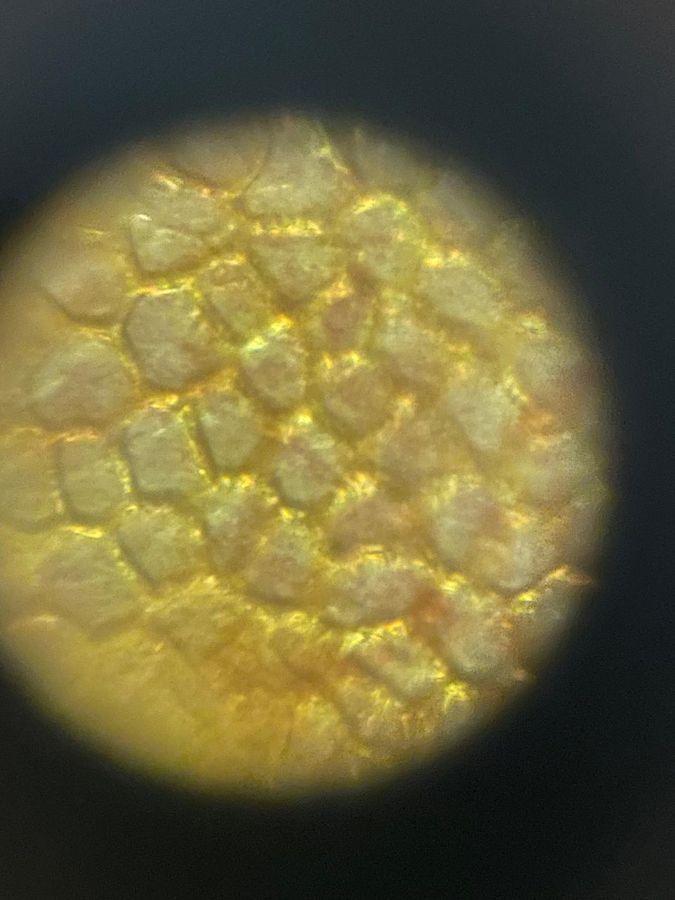
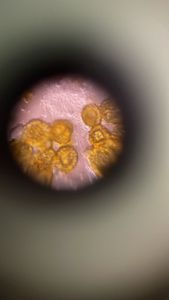
I then moved on to using the 140x lens. Here you could see the cells even more enlarged, and their structure was way more clearly visible now. It seemed like a yellow ocean too, like when the light hits clear blue water and creates patterns, except with yellow. I truly loved how it looked under the microscope.
These are pictures of the Tomato Skin using the 140x lens.
I then moved on to using the 140x lens. Here you could see the cells even more enlarged, and their structure was way more clearly visible now. It seemed like a yellow ocean too, like when the light hits clear blue water and creates patterns, except with yellow. I truly loved how it looked under the microscope.
These are pictures of the Tomato Skin using the 140x lens.


And last but not least, these are pictures of the Tomato Skin using the 340x lens.


Here, you could really start to see how each individual cell looked like, its boundaries and the distribution of pigment within it.
Next up, we prepared our slides for Tomato Flesh.
This was very fun. We were told to take a little bit of the tomato flesh using our nail and then kind of smash it on the slide to extract the liquidy, watery mush, that contained Tomato Flesh cells. You could also run the flesh part against the slide to get a cell sample, that is if it was moist enough.
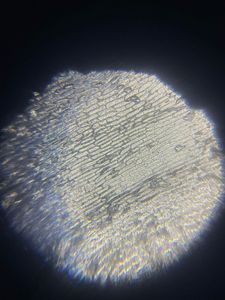
We started off by looking at pictures of the Tomato Flesh using the 50x lens, just like always.
Next up, we prepared our slides for Tomato Flesh.
This was very fun. We were told to take a little bit of the tomato flesh using our nail and then kind of smash it on the slide to extract the liquidy, watery mush, that contained Tomato Flesh cells. You could also run the flesh part against the slide to get a cell sample, that is if it was moist enough.
We started off by looking at pictures of the Tomato Flesh using the 50x lens, just like always.


The cells were very transparent, so much so, that if you didn't know what you were looking for, or if your focus was incorrect, it would have seemed as if there were no cells at all ! This was actually an issue my classmates faced, with the cells "disappearing" although that was with the higher 340x resolution lens. The cells we were observing right now, as shown in the above photographs, were transparent, big, and sparsely scattered. Next up, I looked at the cells using the 140x lens.
These are pictures of the Tomato Skin using the 140x lens.
These are pictures of the Tomato Skin using the 140x lens.


Here, you can see the various components within the tomato flesh cells.
These are pictures of the Tomato Skin using the 340x lens.
These are pictures of the Tomato Skin using the 340x lens.


These pictures show only a part of an individual tomato flesh cell. From this we can infer, that the size of the tomato flesh cells is relatively large in comparison to previously observed samples.
This experience taught me how things aren't always as they seem - we know tomatoes are red, but under a microscope their cells showed us an array of pigments - yellow, orange and even transparent flesh cells. It also taught us a lot about sample-making and not being greedy but instead being patient !
Looking at the tomato under the Foldscope reminded me that even the most ordinary things we eat daily hold extraordinary worlds within them. And this was just one chapter of exploration, with many more to come, as in the following day we would be stepping into the world of pollens.
This experience taught me how things aren't always as they seem - we know tomatoes are red, but under a microscope their cells showed us an array of pigments - yellow, orange and even transparent flesh cells. It also taught us a lot about sample-making and not being greedy but instead being patient !
Looking at the tomato under the Foldscope reminded me that even the most ordinary things we eat daily hold extraordinary worlds within them. And this was just one chapter of exploration, with many more to come, as in the following day we would be stepping into the world of pollens.
Sign in to commentNobody has commented yet... Share your thoughts with the author and start the discussion!
 0 Applause
 0 Comments