LGP26-B3: Day 3
 Jun 04, 2026 • 6:42 AM UTC
 India
India 140x Magnification
 Plants
Chhaya Yadav
Learn about the author...
4posts
0comments
0locations
View in Media Gallery
On day 3, I got the opportunity to observe different samples and even try dark-field microscopy. Before this session, I had only seen diagrams of pollen grains in textbooks. Looking at real samples under a microscope felt completely different. It was exciting to see structures that are normally invisible to the naked eye.
One of the first things we discussed was iodine staining. I learned that iodine can be used to test for starch. If a sample gets stained after adding iodine, it shows the presence of starch. It was interesting to see how a simple stain can reveal information that we otherwise would not know.
Our professor also emphasized the importance of using the right scientific terms while making observations. Instead of simply saying that something looked "different" or "strange," we were encouraged to describe exactly what we saw. This made me realize that science is not just about looking carefully but also about communicating observations clearly.
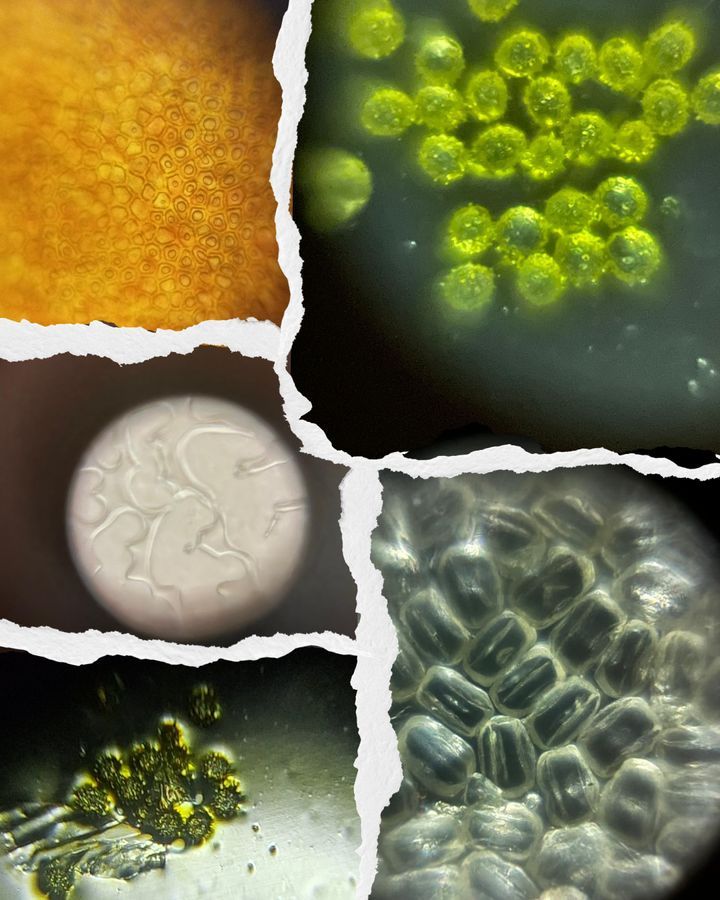
When observing tomato flesh at higher magnification, I could see individual cells. Some appeared orange in colour, and the nucleus was visible in a few of them. There were also round, bubble-like structures of different sizes. At lower magnification, the cell walls became easier to identify, and pigments were more noticeable. Comparing the same sample at different magnifications helped me understand how much detail can change depending on the level of zoom.
The most fascinating part of the session was observing pollen grains. We examined sunflower pollen, which appeared yellow and had tiny spike-like projections on its surface. I had never imagined that pollen could have such mind blowing structures. Under the microscope, it looked almost like a miniature object designed with great detail.
We also observed periwinkle pollen. Unlike sunflower pollen, these grains had a smoother appearance and resembled the shape of a kidney bean. Seeing two different types of pollen side by side made me appreciate the diversity that exists even at microscopic scales.
What I enjoyed most about this activity was the sense of discovery. Every time I adjusted the focus, a new detail seemed to appear. Things that looked ordinary from the outside suddenly became complex and beautiful when viewed through the microscope.
This session reminded me that an entire hidden world exists around us. With tools like the Foldscope, we can explore that world and observe details that we would otherwise never notice. It was a simple but memorable experience that made me more curious about the microscopic side of nature.
One of the first things we discussed was iodine staining. I learned that iodine can be used to test for starch. If a sample gets stained after adding iodine, it shows the presence of starch. It was interesting to see how a simple stain can reveal information that we otherwise would not know.
Our professor also emphasized the importance of using the right scientific terms while making observations. Instead of simply saying that something looked "different" or "strange," we were encouraged to describe exactly what we saw. This made me realize that science is not just about looking carefully but also about communicating observations clearly.
When observing tomato flesh at higher magnification, I could see individual cells. Some appeared orange in colour, and the nucleus was visible in a few of them. There were also round, bubble-like structures of different sizes. At lower magnification, the cell walls became easier to identify, and pigments were more noticeable. Comparing the same sample at different magnifications helped me understand how much detail can change depending on the level of zoom.
The most fascinating part of the session was observing pollen grains. We examined sunflower pollen, which appeared yellow and had tiny spike-like projections on its surface. I had never imagined that pollen could have such mind blowing structures. Under the microscope, it looked almost like a miniature object designed with great detail.
We also observed periwinkle pollen. Unlike sunflower pollen, these grains had a smoother appearance and resembled the shape of a kidney bean. Seeing two different types of pollen side by side made me appreciate the diversity that exists even at microscopic scales.
What I enjoyed most about this activity was the sense of discovery. Every time I adjusted the focus, a new detail seemed to appear. Things that looked ordinary from the outside suddenly became complex and beautiful when viewed through the microscope.
This session reminded me that an entire hidden world exists around us. With tools like the Foldscope, we can explore that world and observe details that we would otherwise never notice. It was a simple but memorable experience that made me more curious about the microscopic side of nature.


Sign in to commentNobody has commented yet... Share your thoughts with the author and start the discussion!

 0 Applause
 0 Comments