LGP26-B3: Exploring Potato Through a Foldscope
 Jun 05, 2026 • 5:04 PM UTC
 India
India 140x Magnification
 Unknown
Ananya Dixit
Learn about the author...
6posts
0comments
0locations
View in Media Gallery
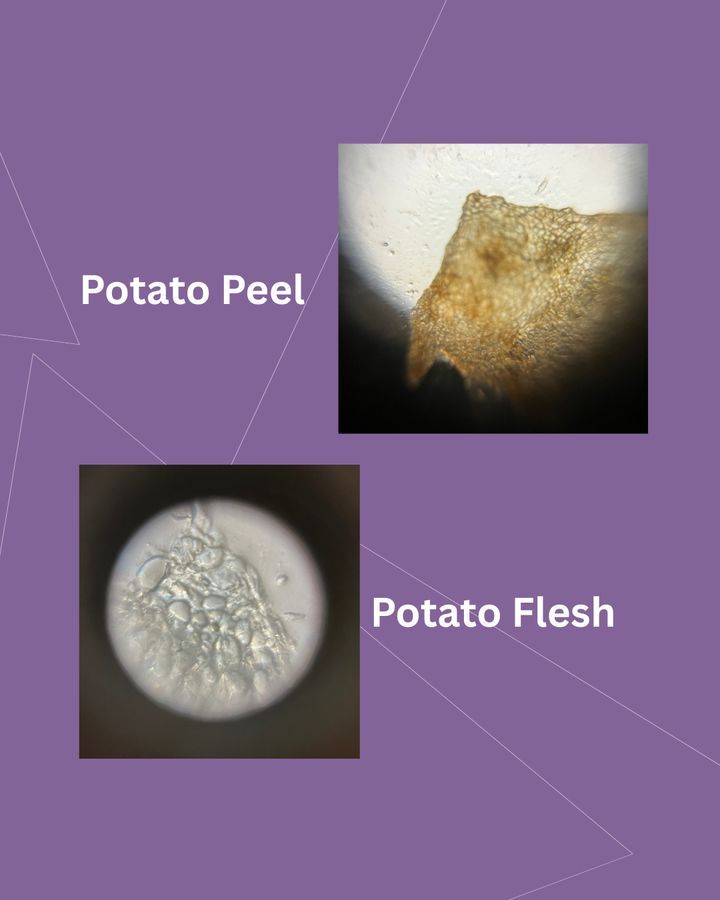
Exploring Potato Through a Foldscope As part of the Exploring the Microcosm course, I observed potato peel and potato flesh under different magnifications using a Foldscope. It was fascinating to see how an ordinary vegetable revealed hidden structures when viewed closely.
Potato Peel At 50x magnification , the peel appeared as a thin protective layer with a rough texture. Some cell boundaries could be noticed, but details were limited.
At 140x magnification , the cells became much clearer. They looked tightly packed together, forming a protective covering around the potato. The organized arrangement of the cells was easier to observe.
At 340x magnification , individual cell walls were visible in greater detail. The peel appeared like a network of connected cells, showing how this outer layer protects the potato from the environment.
Potato Flesh At 50x magnification , the flesh looked more uniform and less structured than the peel. Small dots were visible throughout the sample.
At 140x magnification , these dots became clearer and appeared to be starch granules stored inside the cells. The cells looked larger and less compact than those in the peel.
At 340x magnification , the starch granules were much more distinct. Observing these storage structures helped me understand why potatoes are such an important source of carbohydrates.
This activity showed me that even common foods contain complex microscopic structures. Looking at potato samples through a Foldscope transformed something ordinary into an exciting scientific discovery.
Potato Peel At 50x magnification , the peel appeared as a thin protective layer with a rough texture. Some cell boundaries could be noticed, but details were limited.
At 140x magnification , the cells became much clearer. They looked tightly packed together, forming a protective covering around the potato. The organized arrangement of the cells was easier to observe.
At 340x magnification , individual cell walls were visible in greater detail. The peel appeared like a network of connected cells, showing how this outer layer protects the potato from the environment.
Potato Flesh At 50x magnification , the flesh looked more uniform and less structured than the peel. Small dots were visible throughout the sample.
At 140x magnification , these dots became clearer and appeared to be starch granules stored inside the cells. The cells looked larger and less compact than those in the peel.
At 340x magnification , the starch granules were much more distinct. Observing these storage structures helped me understand why potatoes are such an important source of carbohydrates.
This activity showed me that even common foods contain complex microscopic structures. Looking at potato samples through a Foldscope transformed something ordinary into an exciting scientific discovery.
Sign in to commentNobody has commented yet... Share your thoughts with the author and start the discussion!

 0 Applause
 0 Comments
_300x300.jpeg)
_300x300.jpeg)