LGP 26 B3 POLLEN GRAINS - DAKSH
 Jun 06, 2026 • 7:25 AM UTC
 India
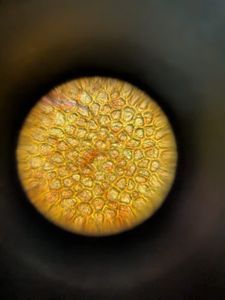
India 50x Magnification
 Plants
Daksh Sethi07
Learn about the author...
6posts
0comments
0locations

View in Media Gallery
Flowers may look beautiful from the outside, but one of their most important structures is almost invisible to the naked eye—pollen. Pollen grains contain the male reproductive cells of a flower and play a crucial role in pollination and reproduction. During the Exploring the Microcosm class at the Lodha Genius Programme, I observed pollen grains from a sunflower and a periwinkle flower using a Foldscope. Although both flowers produce pollen for the same purpose, I was surprised to discover how different their pollen grains looked under the microscope. The differences in shape, texture, and surface structure gave me a glimpse into the incredible diversity that exists even at a microscopic level.
SUNFLOWER POLLEN OBSERVATIONS
At 50× magnification, I could already see that the pollen grains were not smooth. Many of them appeared as small circular structures with rough edges, and some were clustered together. The grains stood out clearly from the background and seemed to have a textured surface rather than a plain one. Even at this magnification, they looked more complex than I expected.
SUNFLOWER POLLEN OBSERVATIONS
At 50× magnification, I could already see that the pollen grains were not smooth. Many of them appeared as small circular structures with rough edges, and some were clustered together. The grains stood out clearly from the background and seemed to have a textured surface rather than a plain one. Even at this magnification, they looked more complex than I expected.

View in Media Gallery
At 140× magnification, the outer surface of the pollen grains became much clearer. The grains appeared almost perfectly round, and I could begin to see tiny projections around their edges. Some grains were overlapping, which made the clusters look like miniature groups of spiky balls. The texture of the pollen was now one of the most noticeable features.
340× Magnification At 340× magnification, the pollen grains looked remarkably detailed. The spiky projections surrounding each grain were clearly visible and gave them a star-like appearance. The spikes seemed evenly distributed around the surface, making the grains look almost like tiny sea urchins. Seeing these structures helped me understand how specialised pollen grains are and how much detail can be hidden within something so small.
340× Magnification At 340× magnification, the pollen grains looked remarkably detailed. The spiky projections surrounding each grain were clearly visible and gave them a star-like appearance. The spikes seemed evenly distributed around the surface, making the grains look almost like tiny sea urchins. Seeing these structures helped me understand how specialised pollen grains are and how much detail can be hidden within something so small.

View in Media Gallery
PERIWINKLE POLLEN GRAINS
50× Magnification At 50× magnification, these groups contained a lot of grains, sometimes overlapping one another.
But still, it was observed that the grains were almost fully transparent with no pigmentation.
50× Magnification At 50× magnification, these groups contained a lot of grains, sometimes overlapping one another.
But still, it was observed that the grains were almost fully transparent with no pigmentation.

View in Media Gallery
At 140× magnification, the shape of the grains became much more noticeable. Most appeared elongated rather than perfectly round, and several showed a faint line running along their length. The grains looked smooth and compact, with a more uniform appearance than the sunflower pollen.
At 340× magnification, the elongated shape of the pollen grains became very clear. A distinct groove running through the centre of many grains was visible, giving them a bean-like appearance. The smooth outer surface contrasted strongly with the spiky texture of the sunflower pollen. Observing the two samples side by side showed how different flowers can produce pollen grains with completely different structures while serving the same reproductive function.
At 340× magnification, the elongated shape of the pollen grains became very clear. A distinct groove running through the centre of many grains was visible, giving them a bean-like appearance. The smooth outer surface contrasted strongly with the spiky texture of the sunflower pollen. Observing the two samples side by side showed how different flowers can produce pollen grains with completely different structures while serving the same reproductive function.


Sign in to commentNobody has commented yet... Share your thoughts with the author and start the discussion!
 0 Applause
 0 Comments


_300x300.jpeg)