Witnessing the fade: Observations on the Decomposition of Porpita porpita
 May 02, 2025 • 4:55 PM UTC
 India
India 50x Magnification
 Animals
_300x300.jpeg)
Sonali Kadam
Learn about the author...
5posts
0comments
2locations
View in Media Gallery
On the morning of April 28, 2025, We collected two Porpita porpita (blue button jellyfish) from Haji Ali beach around 8 AM, placing them in a plastic bottle. They travelled with us through Mumbai’s heat, by local train and auto, reaching home by 12:30 PM. One was small and weak, and the other was larger and healthy.
The healthy one survived for 1 and a half days, the sick one died on the same night.
First Specimen (Smaller, Sick)
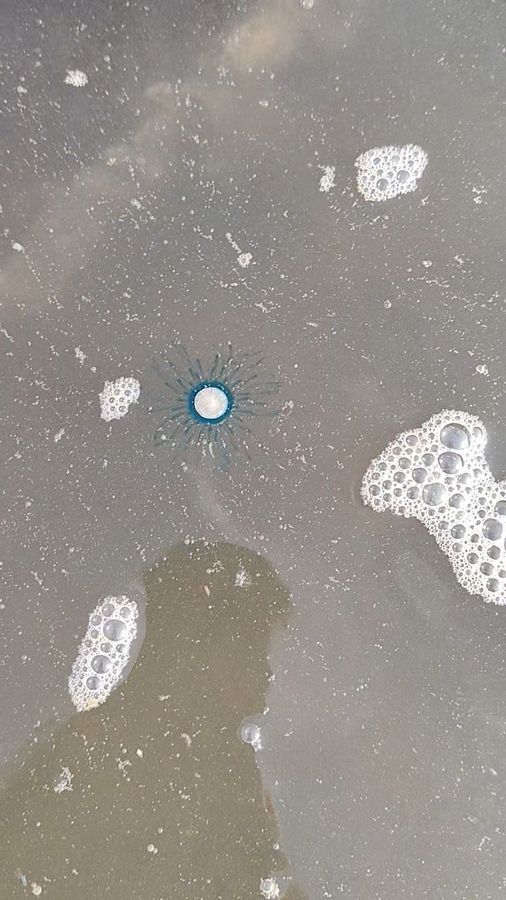
The weaker specimen began deteriorating the same night. Initially, it started losing its blue tentacular zooids/polyps, these zooids seemed to vanish into the water without leaving any visible residue; maybe they disintegrated (autolysis?) into particles too fine to detect with the naked eye or were decomposed or consumed by microbes present in the water —though this remains speculative. After losing all the blue zooids, the bottom disc (which appeared pink when the organism was healthy) began to turn brownish-yellow. The yellowish tissue looked sluggish and decayed! The specimen died completely by the night and only the middle ring was floating on the top. I was wondering how the central ring remained still intact!
The healthy one survived for 1 and a half days, the sick one died on the same night.
First Specimen (Smaller, Sick)
The weaker specimen began deteriorating the same night. Initially, it started losing its blue tentacular zooids/polyps, these zooids seemed to vanish into the water without leaving any visible residue; maybe they disintegrated (autolysis?) into particles too fine to detect with the naked eye or were decomposed or consumed by microbes present in the water —though this remains speculative. After losing all the blue zooids, the bottom disc (which appeared pink when the organism was healthy) began to turn brownish-yellow. The yellowish tissue looked sluggish and decayed! The specimen died completely by the night and only the middle ring was floating on the top. I was wondering how the central ring remained still intact!

View in Media Gallery
Second Specimen (Larger, healthy)
April 29: Maintained a healthy appearance throughout the day.
April 30, Morning: Deterioration process started similar to the first specimen. The blue tentacles began detaching, followed by discoloration of the central float. By the afternoon, only the central disc remained intact.
Additional Observations:
Structural Decomposition: Both specimens underwent rapid decomposition, leaving behind only the central disc. The swift degradation of the hydroid colony, contrasted with the relative persistence of the central float, raises questions about the differential resilience of these structures.
Thread-like Structures: Dipali and I observed thread-like structures in the porpita-her specimen was alive and mine was dead. Initially, I thought it to be external contaminants (e.g., fibres from tissues).
Microscopic Analysis: At 50x and 140x magnification, I saw a constant flow of fluids, maybe showing the cell disruption. While mounting the slide, I added a drop of glycerine and kept it for sometime to settle.
April 29: Maintained a healthy appearance throughout the day.
April 30, Morning: Deterioration process started similar to the first specimen. The blue tentacles began detaching, followed by discoloration of the central float. By the afternoon, only the central disc remained intact.
Additional Observations:
Structural Decomposition: Both specimens underwent rapid decomposition, leaving behind only the central disc. The swift degradation of the hydroid colony, contrasted with the relative persistence of the central float, raises questions about the differential resilience of these structures.
Thread-like Structures: Dipali and I observed thread-like structures in the porpita-her specimen was alive and mine was dead. Initially, I thought it to be external contaminants (e.g., fibres from tissues).
Microscopic Analysis: At 50x and 140x magnification, I saw a constant flow of fluids, maybe showing the cell disruption. While mounting the slide, I added a drop of glycerine and kept it for sometime to settle.


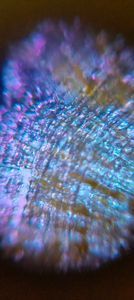


Here is Dipali's slide with thread like structures, looks like filamentous algae or any other filamentous organism?

View in Media Gallery
What Makes the Central Disc of Porpita porpita More Resilient Than Its Tentacles- is it made up of silica?
Sign in to commentNobody has commented yet... Share your thoughts with the author and start the discussion!
 0 Applause
 0 Comments