DAY - 3 LGP 26 B2 : HIBISCUS?
 May 27, 2026 • 8:12 PM UTC
 India
India 340x Magnification
 Plants
Vaibhavi Sahoo
Learn about the author...
7posts
0comments
0locations
_900x900.jpeg)
View in Media Gallery
IS IT HISBISCUS AFTER ALL?
_300x300.jpeg)

Enough of potatoes and onions; it was now time to view something much more complex: pollen grains. I found a random red flower in a garden, and now it definitely resembles a hibiscus, but we won't assume it is one without conducting those fancy genetic tests. So, for now, let us assume it's a red flower.
The petals are a deep pink colour, and they exhibit a delicate, ruffled, and slightly wavy texture. A prominent feature is the central reproductive structure, which displays many small, bright yellow pollen-bearing anthers clustered around the stamen.
Let’s be real: Microscopy is 10% science and 90% me yelling at a tiny piece of paper. It took me 6 or 7 tries to get a decent sample.
Pollen is microscopic, invisible to the naked eye, and apparently, it has a vendetta against being perfectly centered on a slide. It's either "too much pollen" (a chaotic yellow blob) or "too little pollen" (just a lonely grain wandering in a white void).
50 x : GOLDEN DUST
The petals are a deep pink colour, and they exhibit a delicate, ruffled, and slightly wavy texture. A prominent feature is the central reproductive structure, which displays many small, bright yellow pollen-bearing anthers clustered around the stamen.
Let’s be real: Microscopy is 10% science and 90% me yelling at a tiny piece of paper. It took me 6 or 7 tries to get a decent sample.
Pollen is microscopic, invisible to the naked eye, and apparently, it has a vendetta against being perfectly centered on a slide. It's either "too much pollen" (a chaotic yellow blob) or "too little pollen" (just a lonely grain wandering in a white void).
50 x : GOLDEN DUST

View in Media Gallery
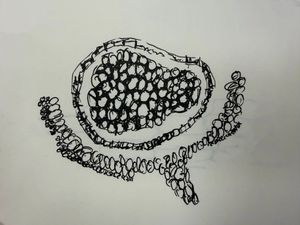
At this distance, the pollen looks like tiny, golden starbursts or rough little asteroids just floating in space. It’s where we realize how much potential life is packed into one speck. The prominent, small, golden-yellow spherical object visible in the upper-left portion of the field is a single pollen grain . It is often spiky or textured to help it adhere to insects or the stigma. The surrounding light-colored, somewhat translucent material is likely a section of the stamen or stigma surface. We can see fine, hair-like structures projecting from the edges.
140x : STICKY AND BUMPY
140x : STICKY AND BUMPY


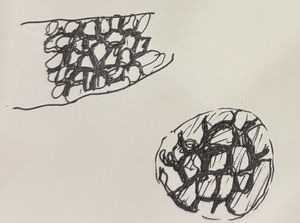
Things are getting clearer. The pollen grain now clearly displays a rough, granular, or "spiky" outer wall. We can see that actually this is 2-3 pollen grains attached very close to each other. This textured surface is an evolutionary adaptation that helps the grain attach to the bodies of pollinators or catch onto the surface of the stigma.
340x : THE WOW MOMENT
340x : THE WOW MOMENT

_300x300.jpeg)
_300x300.jpeg)
At this magnification, we can clearly see the intricate architecture. The surface is covered in these weird, circular protrusions. The most striking feature here is the clearly defined, spiked, or "echinate" surface of the pollen grain. The blurred, fluid-like structures around the pollen grain suggest we are likely looking at it in a moist environment. The darker, denser yellow center is the cytoplasm and the nuclei of the pollen grain.
Science is messy. It’s frustrating. It involves a lot of squinting and adjusting a tiny, flimsy piece of paper until your eyes go crossed. But there is something genuinely cool about realizing that the "dust" you brushed off your clothes is actually a complex, highly evolved biological marvel that looks like a spiky, golden alien egg.
Now, if you’ll excuse me, I have to go wash this yellow stuff off my hands before I sneeze myself into the next century.
Hope my next post comes before the next century. Until then, adiossss!!!
Science is messy. It’s frustrating. It involves a lot of squinting and adjusting a tiny, flimsy piece of paper until your eyes go crossed. But there is something genuinely cool about realizing that the "dust" you brushed off your clothes is actually a complex, highly evolved biological marvel that looks like a spiky, golden alien egg.
Now, if you’ll excuse me, I have to go wash this yellow stuff off my hands before I sneeze myself into the next century.
Hope my next post comes before the next century. Until then, adiossss!!!
Sign in to commentNobody has commented yet... Share your thoughts with the author and start the discussion!

 0 Applause
 0 Comments