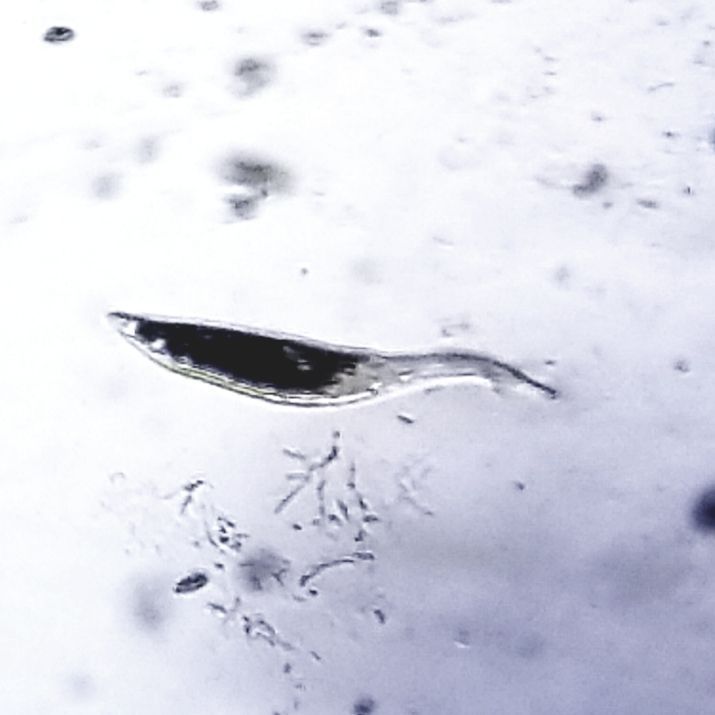
Dileptus another Apex predator
 Sep 25, 2025 • 2:01 PM UTC
 United States
 140x Magnification
 Microorganisms
Laks Iyer
Human observer of life. https://sukshmadarshin.wordpress.com
97posts
1255comments
5locations
View in Media Gallery
Many of you will be familiar with the remarkable work on Lachrymaria from Manu’s group. In that study, Manu coined a term that has stayed with me ever since: lachrygamy. Their seminal paper revealed how Lachrymaria can extend its neck nearly 30 times the length of its body through a process resembling the unfolding of curved-crease origami. It’s one of the most dramatic examples of cellular engineering in nature, and the accompanying video captures it beautifully:
👉 Stanford News: The First Example of Cellular Origami
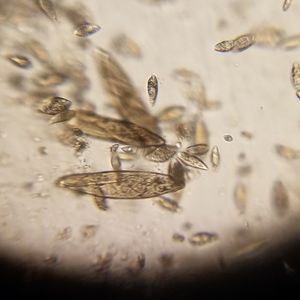
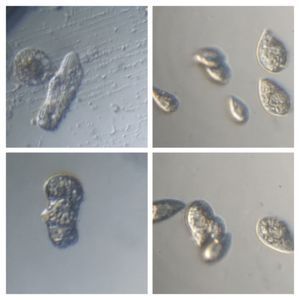
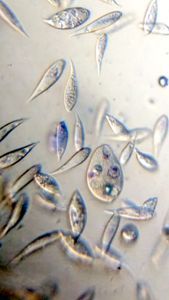
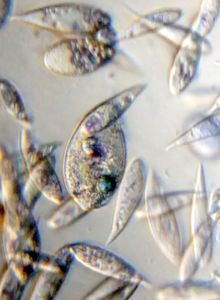
Lachrymaria belongs to a class of ciliates known as Litostomatea , whose cilia arise from structures in the cortex called monokinetids . Today I encountered another member of this class—one that looks superficially similar to Lachrymaria but behaves very differently. Instead of telescoping its neck, it relies on a fixed proboscis. It deploys its toxocysts in much the same way and instead features a subapical mouth. But it dwarfs its cousin in size and calls to mind a miniature Loch Ness monster. This is the apex predator, the terrifying Dileptus , a monster in a drop of water.
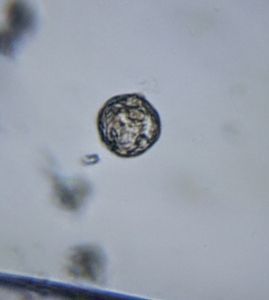
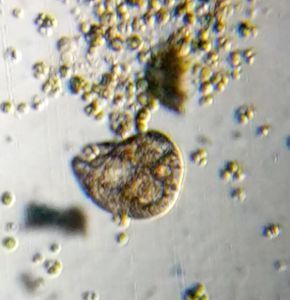
In Dileptus , the proboscis doesn’t extend like Lachrymaria ’s neck, but the shape (and perhaps some intracellular features) echo its relative. What’s especially fascinating is its macronucleus which is made up of hundreds of nodules , giving the cell a granular, jewel-like interior. Despite being an apex predator, Dileptus is paradoxically fragile, prone to bursting apart under the slightest coverslip pressure. A delicate beast, hiding its vulnerability behind its ferocity. There is also something about how many Dileptus ciliates can be in an area. Some kind of predator prey equilibrium that needs to be understood. Otherwise it grows with a prey such as Chilomonas which needs some bacterium that grows in mineral water seeded with a a wheat grain. A lot of luck is needed. So far I got lucky
👉 Stanford News: The First Example of Cellular Origami
Lachrymaria belongs to a class of ciliates known as Litostomatea , whose cilia arise from structures in the cortex called monokinetids . Today I encountered another member of this class—one that looks superficially similar to Lachrymaria but behaves very differently. Instead of telescoping its neck, it relies on a fixed proboscis. It deploys its toxocysts in much the same way and instead features a subapical mouth. But it dwarfs its cousin in size and calls to mind a miniature Loch Ness monster. This is the apex predator, the terrifying Dileptus , a monster in a drop of water.
In Dileptus , the proboscis doesn’t extend like Lachrymaria ’s neck, but the shape (and perhaps some intracellular features) echo its relative. What’s especially fascinating is its macronucleus which is made up of hundreds of nodules , giving the cell a granular, jewel-like interior. Despite being an apex predator, Dileptus is paradoxically fragile, prone to bursting apart under the slightest coverslip pressure. A delicate beast, hiding its vulnerability behind its ferocity. There is also something about how many Dileptus ciliates can be in an area. Some kind of predator prey equilibrium that needs to be understood. Otherwise it grows with a prey such as Chilomonas which needs some bacterium that grows in mineral water seeded with a a wheat grain. A lot of luck is needed. So far I got lucky
Phylogenetics of this is quite surprising. In evolutionary trees, Lachrymaria clusters not with Dileptus , but rather with another extraordinary predator: Didinium . Check out this article by Peter Vďačný and colleagues

View in Media Gallery
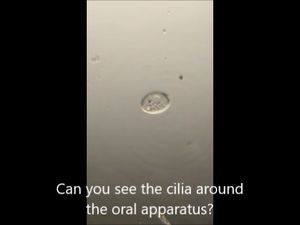
This ciliate, Didinium, armed with rings of cilia, can decimate a culture of Paramecium in just days. Here’s a video I captured over six years ago with a Foldscope. It still amazes me how destructive it is in a Paramecium culture
View in Media Gallery
Just a final thought, the above tree suggests that the proboscis was lost in Didinium. Essentially, the proboscis was a way of delivery of the toxins in toxocysts. In some instances it evolved a stringy phenotype so that it could grab prey many cell lengths away. Perhaps the mouth moved to the tip as a result. In other instances it was lost entirely, which was perhaps fueled by the faster physical movement of the ciliate. Phylogenetic trees though often change with more data.
Sign in to commentNobody has commented yet... Share your thoughts with the author and start the discussion!
_300x300.jpeg)
 0 Applause
 0 Comments